Summary Hezbollah risks revenge attacks by Sunni rebels as they snatch Qusair victory for Assad.
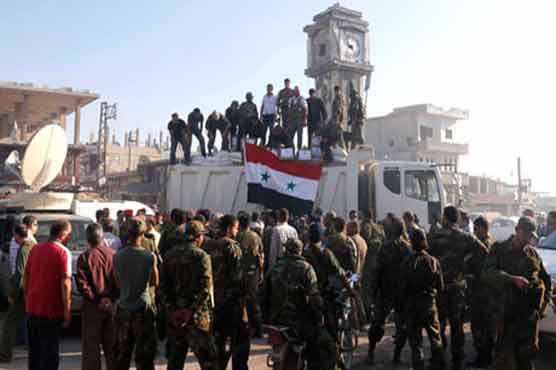
BEIRUT (Reuters) - The capture of Qusair by Syrian troops spearheaded by Hezbollah, the Lebanese Shi ite Islamist militia, risks turning the war in Syria into a wider sectarian battle between Sunni and Shi ite forces that will sweep through the country s neighbours.
The fall of the town after weeks of fighting has emboldened the Syrian government and left the rebels contemplating their biggest defeat in a two-year-old war that has killed 80,000.
In Damascus, the victory lifted the morale of a government under siege. Demonstrations in support of President Bashar al-Assad are back, and posters of his family can be seen once more on cars circulating on inner city streets.
Opposition activists voiced anger at the chronic disunity of their fighters and the failure of Arabs and the West to arm the rebel groups.
"The other side is fighting under one banner but we are fighting under several banners," said activist Yasser Alyousef on the Facebook page Aleppo Now.
The fighting now threatens to take on a more sectarian and regional focus. The withdrawal of Sunni Syrian rebels into eastern Lebanon could mean reprisal attacks on Shi ite villages and Hezbollah strongholds there.
"The loss of Qusair and the very high number of casualties reported from the town will undoubtedly result in a desire amongst at least some of the rebel community to exact revenge," said Charles Lister, an analyst at IHS Jane s terrorism and insurgency centre.
A senior security official in the region put it more bluntly: "Hezbollah entered a Sunni-Shi te conflict (in Syria) declaring a jihad so they expect a counter jihad in return."
The fall of Qusair is a strategic blow to the rebels, who have suffered reverses in a government counter-offensive now reinforced by Hezbollah and Revolutionary Guards from Iran.
Rebel supply lines through Qusair are now cut, while the government has regained control of the Damascus to Aleppo highway. The government has also regained access from Damascus to the coastal heartland of Assad s loyal Alawite minority.
What is most unsettling about the capture of Qusair, military officials in the region say, is that it was essentially a Hezbollah operation - from the planning, to the deployment of artillery and other armaments, to the actual fighting.
"Hezbollah captured the town and let the Syrian army in. The Syrian army provided logistical support through relentless bombing and shelling, but Hezbollah was the strike force," said one well-placed Syrian source.
The involvement now of Hezbollah, Iran s proxy, in the war is seen as evidence of a belief in Tehran that a defeat for
Assad -- which looked distinctly possible last year – would pose an unacceptable threat to Iran.
Qusair is unlikely, however, to prove a decisive turning point in a stalemated war. Forces loyal to Assad must still retake large areas of northern and eastern Syria, while the rebels, divided and poorly armed as they are, remain tenacious.
"It is a very strategic win, but a localised victory which took several weeks and with huge foreign assistance which has a lot of negative connotations. There will definitely be a reaction against Hezbollah," said Middle East analyst Rami Khouri.