Summary Thousands of Muslims lost their homes in a deadly rampage by Buddhist mobs in March.
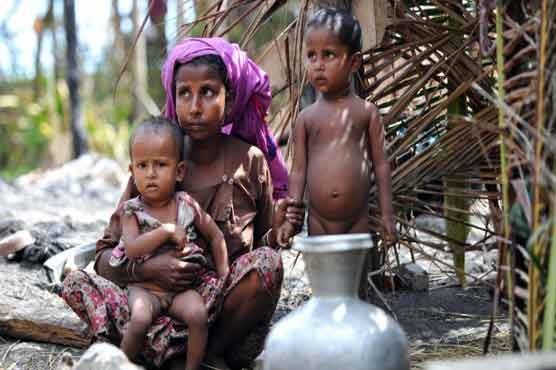
MEIKHTILA (Agencies): In Myanmar s central heartlands, justice and security is elusive for thousands of Muslims who lost their homes in a deadly rampage by Buddhist mobs in March.
Many are detained in prison-like camps, unable to return to neighborhoods and businesses razed in four days of violence in Meikhtila that killed at least 43 people, most of them Muslims, displaced nearly 13,000, and touched off a wave of anti-Muslim unrest fuelled by radical Buddhist monks.
"It s for their own security," said a police officer at a camp inside a sports stadium on Meikhtila s outskirts. The camp holds more than 1,600 people guarded by police with orders not to let them leave, said the officer, who declined to give his name.
A dawn-to-dusk curfew has been in force in Meikhtila since the government declared martial law on March 22. Skeletal walls and piles of rubble are all that remain of Muslim homes and businesses that once covered several blocks at the heart of the town of 100,000 people in the center of Myanmar.
Trials have begun, but so far only Muslims stand accused, raising fears that courts will further aggravate religious tension by ignoring the Buddhist ringleaders of the violence.
The unrest and the combustible sectarian relations behind it are one of the biggest tests of Myanmar s reform-minded government, which took power in March 2011 after almost half a century of hardline military rule.
Myanmar is a predominantly Buddhist country, but about 5 percent of its 60 million people are Muslim. They face a growing campaign of anti-Islamic sentiment led by radical Buddhist monks.
An independent commission released a report on Monday saying Myanmar must urgently address the plight of Muslims displaced by sectarian bloodshed in western Rakhine State. It came in response to violence last June and October that killed at least 192 people and left 140,000 homeless, mostly stateless Rohingya Muslims in an area dominated by ethnic Rakhine Buddhists.
The trial of seven Muslim men accused of murdering a monk, believed to be the first killing in the March unrest in Meikhtila, is expected to conclude this week. Those on trial say they are innocent.
The sound of hammers ring across the city as workers dismantle what is left of the Muslim neighborhood, stone by stone. There are no signs of Muslims on the streets.
More than 8,000 Muslims are being held in seven official camps that are off-limits to journalists. Thousands more have crowded into unofficial camps in villages near Meikhtila, where police also restrict their movements and prevented them from speaking with Reuters.
Phil Robertson, deputy director of Human Rights Watch s Asia division, said detaining internally displaced people (IDP) is a violation of their rights.
Spokesmen for the president s office did not respond to requests for comment.
One of the office s spokesmen, Ye Htut, has previously stressed that the monks involved in the Meikhtila violence make up only a fraction of the 500,000-strong monkhood. "All perpetrators of violence will be prosecuted to the fullest extent of the law," said President Thein Sein in a nationally televised speech on March 28.
Victims in relief camps "live freely and happily", reported the state-run New Light of Myanmar newspaper on April 5.
The government has promised to help Muslims rebuild their homes, but reconstruction has yet to begin. Building more than 1,500 houses burned down or damaged would cost $7 million, it said.
Some Buddhist residents said returning Muslims were unwelcome.
Such hostility could influence the outcome of the ongoing murder trial, suggested Thein Than Oo, a lawyer for three of the seven Muslim accused, who believed the judge is under pressure from Buddhists to deliver a guilty verdict.
"He has to satisfy the people," he said.
He pointed to the case of the Muslim owner of a gold shop, his wife and an employee who on April 11 received 14 years without parole for theft and assault. The charges stemmed from an argument with a Buddhist customer, which sparked the first bout of rioting earlier on the day the monk was killed.
The court imposed harsh sentences due to the violence that erupted afterwards, said Thein Than Oo.
Most victims of the rioting were Muslim but no Buddhists have appeared in court. The district judge said they would be tried after the current trial ends.
Neither the judge nor the district police could say if any monks would be charged. Monks led many of the mobs, according to dozens of witnesses.