Updated on
Summary Portugal was forced to take a bailout from EU and IMF in May last year.
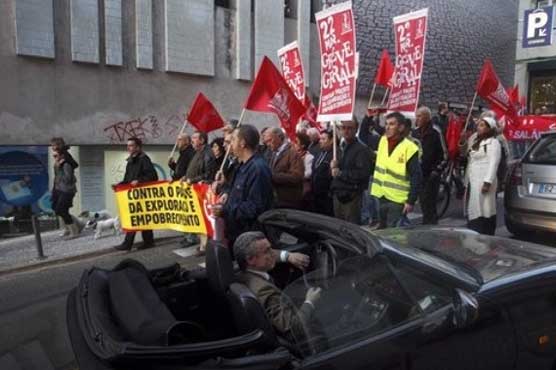
Portuguese workers halted trains, shut ports and paralyzed most public transport in the capital Lisbon on Thursday in protest at austerity measures and labor reforms imposed as a condition of a 78-billion-euro ($103 billion) bailout.Occupy the streets, block everything is one of the slogans adopted by the workers, who say the reforms turn the clock back on employment rights, ramp up joblessness and erode living standards.Portugals largest union, the CGTP, aims to bring the country to a standstill, but the Portuguese have so far shown little interest in imitating the kind of protests seen in Greece. One trade union, the UGT, the countrys second-largest, has signed up to the reforms, and private sector workers have been reluctant to commit to the strike.Portugal, facing its worst recession since the 1970s, was forced to take a bailout from the European Union and International Monetary Fund in May last year after running up large debts. Some economists say it might need a second bailout as the recession deepens, putting its budget targets in doubt and jeopardizing its planned return to the bond markets late next year.Strike organizers said the countrys railway transport was paralyzed, including the international Lisbon-Madrid route. Lisbons underground was shut at midnight. Many hospitals were only accepting emergencies.The centre-right government is betting that relative public apathy will help it impose painful spending cuts and policy reforms to drag the country out of its debt crisis.The UGT, which is allied to the opposition Socialist Party, has urged opponents of austerity to show restraint, warning that Portugal could descend into the kind of chaos seen in Greece.But the CGTPs new Communist leader, Armenio Carlos, is eager to fight the measures.The strikers say the new labor laws, which make it easier to hire and fire staff and which cut compensation for workers, mark the biggest step backwards for workers since Portugals return to democracy in 1974 after military rule.The strike will be a sort of a test for the new union leadership, said Jose Adelino Maltez, a political scientist at Lisbon Technical University.They will try to show that they can go beyond the usual stoppages in the public service and transport, that the movement is broader than its Communist supporters.With public transport shut down or running skeleton services, the main impact of the strike could be in stopping people getting to work.I dont expect the country to stop, but we can expect a strong showing, maybe with some export-oriented companies halting output, to give a signal that there is a strong unionized force in Portugal to be reckoned with, said Maltez.