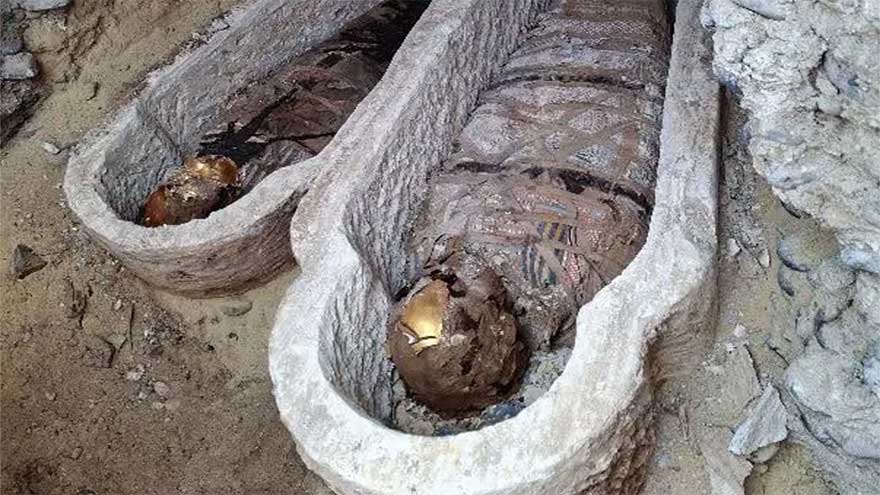
Summary Several mummies were found in wooden coffins, wrapped in linen featuring elaborate geometric patterns on them.
(Web Desk) - Archaeologists have uncovered a mysterious tomb in Egypt filled with golden mummies.
But not only were their heads painted gold, they also had bizarre golden tongues.
The tomb was unearthed in Egypt‘s historic El-Bahnasa in Minya, about 120 miles south of the capital Cairo, an area known for being rich with archaeological and spiritual wonders.
These latest digs reveal tombs dating back to the Roman era and shed light on the types of funerals carried out by the Greco-Roman civilisation, which dominated the world more than 1,300 years ago.
Several mummies were found in wooden coffins, wrapped in linen featuring elaborate geometric patterns on them.
There are traces of gold leaf – and their heads can clearly be seen shinning in gold.
But curiously so too are their tongues.
Experts found three golden tongues and one copper tongue inside the skulls.
This is thought to be part of a special ritual, under the belief that it would allow the dead to speak in the afterlife.
It’s a common and deeply symbolic religious act that was carried out at the time.
And that’s not all archaeologists found.
A rare papyrus – used by Egyptians to write on – was discovered inside one mummy.
It featured a passage from the ancient Book II of Homer’s Iliad.
Sherif Fathy, Egypt’s Minister of Tourism and Antiquities, celebrated these latest discoveries for revealing more about the richness and diversity of Egyptian civilisation throughout the ages.
The dig was carried out by scientists at the University of Barcelona and the Institute of the Ancient Near East.