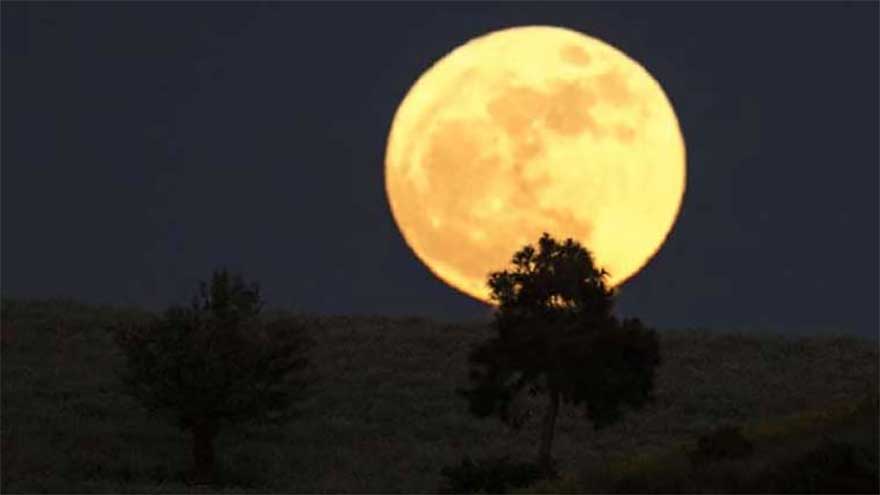
Summary It will continue to mesmerise people on Friday night also. Supermoons happen because the Moon's orbit around Earth isn't a perfect circle. It's elliptical, or slightly egg-shaped.
ISLAMABAD (Dunya News) - Stargazers enjoyed a breathtaking view of the last supermoon of 2025 when it lit up skies across Pakistan on Thursday night.
The last supermoon of 2025 will continue to mesmerise people on Friday night also.
Why is this full Moon so high? It's to do with Earth's tilt as it orbits the Sun, but essentially, the Moon is doing the opposite of what the Sun is doing.
The Moon is full when it's in the opposite part of the sky from the Sun, which is why the whole of the Earth-facing side of the Moon is illuminated (i.e. why it's 'full').
And because the Sun is low in winter, the Moon is high.
That makes the Cold Moon one of the best, easiest full Moons to see all year.
If you watch the nearly-full Moon rise on Wednesday 3 December 2025, you may notice it's close to a small group of stars that appear like a 'smudge' to the naked eye.
This is the Pleiades open star cluster, and through binoculars it looks like a mini 'Big Dipper'.
The Cold Moon will appear to pass in front of the Pleiades on Wednesday night, moving right to left from our perspective, in an event known as a lunar occultation.
This lunar occultation of the Pleiades will occur late in the evening on 3 December for observers in North America; in the UK and Europe it will happen after midnight on 4 December.
If you observe the Moon passing across the Pleiades through binoculars or a telescope, you'll be able to watch as it obscures individual stars in the cluster.
A good stargazing app should enable you to pinpoint when the event will happen from your location.
The December 2025 Cold Moon is the third and final supermoon of 2025 (the other two having occurred in October and November), meaning it's your last chance to see a supermoon this year.
Supermoons happen because the Moon's orbit around Earth isn't a perfect circle. It's elliptical, or slightly egg-shaped.
That means sometimes the Moon is closer to Earth than at other times.
When the Moon is at its farthest point from Earth, it's at 'apogee'. When it's at its closest point to Earth, it's 'perigee'.
And when the Moon is full at perigee, it appears slightly bigger and brighter than usual, which is why it's become known as a 'supermoon'.