
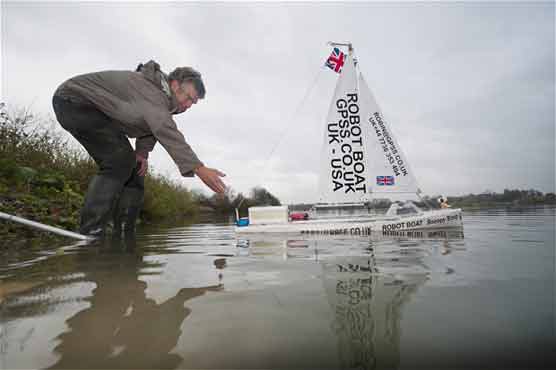
Summary A retired Nato scientist will this week launch his toy boat – which has already sailed 5,500 miles.
Robin Lovelock has spent four years developing a craft he believes can survive the 6,000 mile journey.
It sounds like an unlikely conqueror of the Atlantic - only 4ft long, weighing just 30lbs and held together in parts by bathroom light cord.
But this week a toy boat called Snoopy Sloop will follow in the wake of Transatlantic pioneers like Christopher Columbus when it attempts to become the first craft to make an unmanned crossing of the ocean.
Its creator Robin Lovelock, a retired Nato scientist, has spent four years developing a craft he believes can survive the 6,000 mile journey.
The vessel has already demonstrated its endurance, having completed more than 5,000 miles during seven months of almost continuous sailing, albeit on the gentler waters of Bray Lake, just off the M4 motorway near Windsor.
Now it faces a more testing voyage, battling the seas, and possibly storms, of the North Atlantic, despite being a fraction of the size of shipping which normally makes the winter crossing.
Mr Lovelock, 65, has assembled the vessel in the games room of his house in Sunninghill, Berkshire, from off-the-shelf parts scoured from the internet at a cost of less than £450. The boat will be powered by the wind, but navigated by a solar-powered computer and GPS system.
These will control the rudder and – it is hoped – steer the boat on a preprogrammed route along the Channel, then south towards the Azores to catch the trade winds to the Bahamas and onwards to land near the spot where the Pilgrim Fathers came ashore at Plymouth, Massachusetts.
A tracking device will emit a signal every hour to update Mr Lovelock back home about the boat’s progress – or otherwise.
The 30lb vessel is expected to crawl along at around three miles an hour and – if all goes to plan – will not reach its destination for up to six months.
Weather permitting, it will begin its Transatlantic journey from Barton-on-Sea, Hampshire, on Saturday. Autumn is not the most auspicious time to cross the Atlantic, in any sort of vessel, but there is no time to spare as the craft could face competition.
The attempt is being made as part of an international contest, the Microtransat Challenge, to become the first to send an unmanned from south of Ireland to the Bahamas.
Competitors can set off whenever they wish. So far, three attempts have been made since the transatlantic challenge began in 2010 – two by French academics and one by a team from the University of Aberystwyth – all of which have been defeated by a combination of technology failures and the weather.