Updated on
Summary The US will scale back Mars exploration due to budget proposal by President Barack Obama.
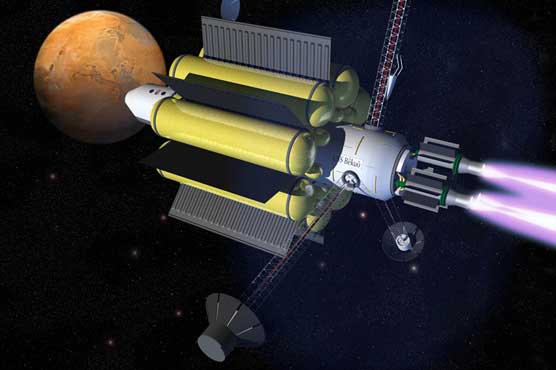
The United States will scale back Mars exploration under a proposed budget by President Barack Obama released Monday that has some scientists fuming over the risk of a NASA brain-drain.The plan kills a deal between the US and European space agencies to cooperate on Mars robotic rover missions in 2016 and 2018, with a view to preparing to return samples from the red planet in the next decade.It is a real scientific tragedy and I personally believe it is a national embarrassment, G. Scott Hubbard, a Stanford University professor who served as the first NASA Mars program director, told AFP.Here we had one of the most successful NASA programs of the last decade and it is being effectively turned off.NASA administrator Charles Bolden admitted that tough choices had to be made in axing the European deal, but vowed to restructure the Mars program so that future robotics mission could potentially be revisited in 2018-2020.The fiscal 2013 budget, which is unlikely to face a vote in Congress while Obama seeks re-election, called for a $226 million reduction, or a near 39 percent cut in the US space agencys Mars exploration program.Meanwhile, it funds other big projects such as the James Webb Space Telescope and a new heavy-lift rocket to propel an eventual deep space mission to an asteroid, and provides seed money for private companies seeking to replace the space shuttle which was retired last year.The overall proposal is to give NASA $17.7 billion, a decrease of 0.3 percent or $59 million less than 2012.Obamas budget pointed to the successful launch last year of the Mars Science Laboratory, also known as Curiosity, the biggest and most advanced rover ever built which should land in August, as it called for reduced support for new robotic projects.But according to Bill Nye, chief executive of the Planetary Society, an association of scientists skilled in the search for alien life, such program cuts could have devastating consequences.We are concerned that once planetary exploration programs are stopped, they just cant be restarted, Nye told AFP.NASA currently employs the worlds top experts in landing robotic vehicles on Mars, he said, noting that the recent failure by Russia to get its Mars probe off to a successful launch provides evidence of the danger.If all the (NASA) people expert in Entry, Descent, and Landing (EDL) on Mars have no missions and then retire, the program just cannot recover, Nye said.Russia has been floated as potential partner with Europe in the ExoMars project should the United States withdraw.According to the ExoMars deal NASA and ESA made in 2009, NASA would have contributed $1.4 billion to the project and ESA would have chipped in $1.2 billion.The ExoMars plan would have sent an orbiter to Mars in 2016 and called for two rovers to land on the red planet in 2018.Tens of millions of US dollars have already been spent on the plans, according to Hubbard.John Logsdon, an external White House adviser and longtime space analyst, said the United States withdrew from ExoMars because it cannot afford now to commit itself to another multi-billion dollar project.