Summary Modern warfare is no longer only a war of guns, missiles, drones, or explosives. It is increasingly a war of information, surveillance, speed, analysis, and the ability to connect scattered signals
DUBAI (Syed Mudassir Khushnood) – If a person does not use a mobile phone, does not carry any obvious electronic device, and begins to live quietly within a limited circle, does he really disappear from the eyes of the world?
This very question has resurfaced with renewed intensity following recent events in the Middle East. The assassination of Iran’s Supreme Leader Ayatollah Ali Khamenei, initially reported by Iranian state media and later by Reuters and other international news outlets, along with the subsequent leadership transition in Iran and the broader regional tensions, have deepened the debate about how modern high-value targets are ultimately located.
It is clear that the specific technologies used in any particular operation are rarely confirmed openly. However, one thing has become increasingly evident: modern warfare is no longer only a war of guns, missiles, drones, or explosives. It is increasingly a war of information, surveillance, speed, analysis, and the ability to connect scattered signals.
Today, the target is not always what can be seen. Sometimes the target is what can be heard, sensed, or detected as a pattern within information.
This is where an unusually important question arises: Can sound itself become a clue?
Sound: invisible, yet leaving traces
In the military and intelligence world, using sound as a clue is not a new concept. In the past, acoustic methods were used to determine the direction of gunfire, estimate the position of artillery, and trace the origin of explosions.
What has changed today is that artificial intelligence, high-speed computing systems, and listening devices deployed across multiple locations have given this old concept a new level of power.
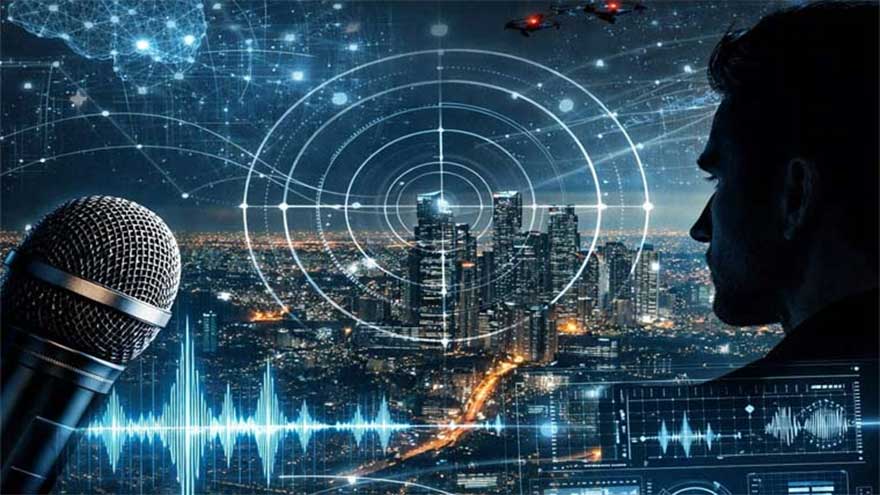
If sensitive acoustic sensors or other listening devices are placed in different locations within a specific area, sounds generated by a person’s speech, movement, or environment may reach them at slightly different times. By analyzing these small differences in timing, direction, intensity, and echoes, it can be estimated where the sound originated and what its likely source might be.
This concept has a scientific foundation and is used in techniques such as audio source localization, beamforming, and time-difference measurement.
The real question is not whether a sound was heard. The real question is who heard it, from where, and with which other clues it was combined.
Voice Biometrics
Another important aspect of this discussion is voice biometrics. This technology treats the human voice as a unique biological identity.
Just as fingerprints or facial structure help identify a person, the human voice also contains characteristics that distinguish one individual from another.
The rise and fall of tone, speaking speed, breathing intervals, stress patterns in speech, pronunciation of words, and frequency characteristics together form an acoustic signature that artificial intelligence can record and recognise.
This is why even a short speech, a brief conversation, or a small audio sample can provide identifying clues.
However, it is important to understand a fundamental distinction here: identifying a voice and locating a voice are not the same thing.
Voice biometrics can suggest which person the voice resembles, but it does not necessarily reveal where that person is located. Determining the location requires a structured listening network, information gathered from multiple angles, and additional analysis.
The environment also speaks
A lesser-discussed but highly important aspect of modern intelligence is that sometimes the environment around a person speaks louder than the person’s own voice.
The echo of a closed room, the continuous hum of a fan or air conditioner, the vibration of a generator, distant traffic, the rhythm of industrial machinery, or the acoustic characteristics of a specific building can all provide clues about a location.
Artificial intelligence does not examine these signals separately; it attempts to understand them together. In this way, even a small acoustic signal may carry with it a broader acoustic map of its surroundings.
In some cases, subtle acoustic patterns in sound propagation and echo reflections can also help with analysis, particularly when they are combined with information gathered from other sources.
These estimates are not always definitive. However, when such clues are combined with aerial surveillance, ground observation, patterns of daily activity, and human intelligence, a clearer picture can emerge.
The real power: listening networks and data fusion
This is where the true face of modern warfare becomes visible.
A single microphone or listening device can only indicate that a sound was heard. But if the same sound is detected from multiple directions, the differences in time and angle can help estimate the possible location of its source. If this analysis is done quickly, even potential movement can be inferred.
In reality, modern high-value targeting is rarely the result of a single technology. The real power lies in integrating information gathered from multiple sources.
Aerial imagery, drone surveillance, ground sensors, thermal signals, behavioural patterns, human intelligence sources, and sometimes acoustic clues — when all of these are combined within a single analytical system, they create an intelligence picture in which a person is no longer just an individual, but a data pattern that can be analysed.
This is why some defense experts say that in modern warfare, the decision is often partially made in the world of information before the bullet or missile is ever fired.
But is it all infallible?
Certainly not.
This is where caution becomes necessary.
Sound weakens in the air, gets drowned in noise, changes when it reflects off buildings, and creates echoes in enclosed spaces. In dense urban environments, a single sound may reflect from multiple surfaces.
If the listening system is incomplete, the recording is poor, or the environment has been deliberately altered, the conclusion can be wrong.
As technology becomes more powerful, the risk of misidentification also increases. Modern analysis may provide speed, but it does not always deliver absolute truth.
What question did the recent event in Iran raise?
After the recent event in Iran, the central question is this:
Is it still possible to protect high-value individuals simply through walls, guards, secret locations, and restricted communication?
Or do new threats now emerge from silent clues formed by sound, environment, behavioural patterns, and the fusion of multiple streams of information?
Following the death of Ali Khamenei, the emergence of Mojtaba Khamenei as a new leadership figure, and the broader crisis surrounding these developments — as reflected in statements from Iranian leadership, US intelligence circles, and Israeli officials — it has become increasingly clear that the battlefield is no longer confined to land or air. It has expanded into the architecture of information itself.
Conclusion
In the modern era, true power lies not only in weapons but also in information.
Tracing sound may be possible, but it requires a listening network, technologies capable of interpreting the signals, and a structured analytical system capable of combining clues from multiple sources.
Voice biometrics may open the door to identification. The surrounding environment may hint at location. A network of sensors may construct a possible map.
Perhaps the most unsettling aspect of future warfare is that a person may no longer be recognised solely through their physical presence, but through the informational shadow surrounding them.
And it may be that in the coming age, the most dangerous weapon will not be the one that can be seen, but the one that silently listens, connects, interprets — and eventually finds a human being not through their body, but through the data shadow they leave behind.