
Updated on
Summary Curiosity rover will take 8 months to reach Mars following a journey of 570 million kilometers.
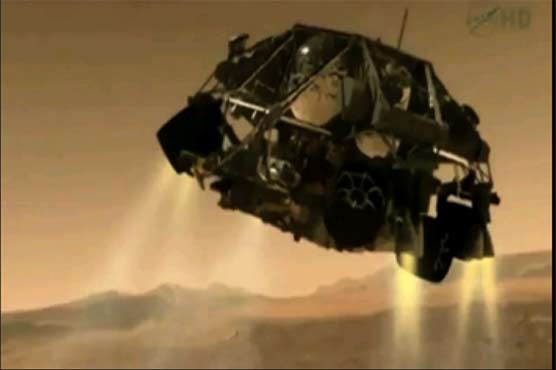
The worlds biggest extraterrestrial explorer, NASAs Curiosity rover, rocketed toward Mars on Saturday on a search for evidence that the red planet might once have been home to itsy-bitsy life.It will take 8½ months for Curiosity to reach Mars following a journey of 354 million miles (570 million kilometres).An unmanned Atlas V rocket hoisted the rover, officially known as Mars Science Laboratory, into a cloudy late morning sky. A Mars frenzy gripped the launch site, with more than 13,000 guests jamming the space centre for NASAs first launch to Earths next-door neighbor in four years, and the first send-off of a Martian rover in eight years.NASA astrobiologist Pan Conrad, whose carbon compound-seeking instrument is on the rover, had a shirt custom made for the occasion. Her bright blue, short-sleeve blouse was emblazoned with rockets, planets and the words, Next stop MarsConrad jumped and cheered as the rocket blasted off a few miles (kilometers) away.Its amazing, she said, and its a huge relief to see it all going up in the same direction.The 1-ton Curiosity as large as a car is a mobile, nuclear-powered laboratory holding 10 science instruments that will sample Martian soil and rocks, and analyze them right on the spot. Theres a drill as well as a stone-zapping laser machine.Its really a rover on steroids, said NASAs Colleen Hartman, assistant associate administrator for science. Its an order of magnitude more capable than anything we have ever launched to any planet in the solar system.The primary goal of the $2.5 billion mission is to see whether cold, dry, barren Mars might have been hospitable for microbial life once upon a time or might even still be conducive to life now. No actual life detectors are on board; rather, the instruments will hunt for organic compounds.Curiositys 7-foot (2.1-metre) arm has a jackhammer on the end to drill into the Martian red rock, and the 7-foot (2.1-metre) mast on the rover is topped with high-definition and laser cameras. No previous Martian rover has been so sophisticated or capable.With Mars the ultimate goal for astronauts, NASA also will use Curiosity to measure radiation at the red planet. The rover also has a weather station on board that will provide temperature, wind and humidity readings; a computer software app with daily weather updates is planned.