Updated on
Summary A big asteroid is set to make its closest flyby of Earth in 200 years.
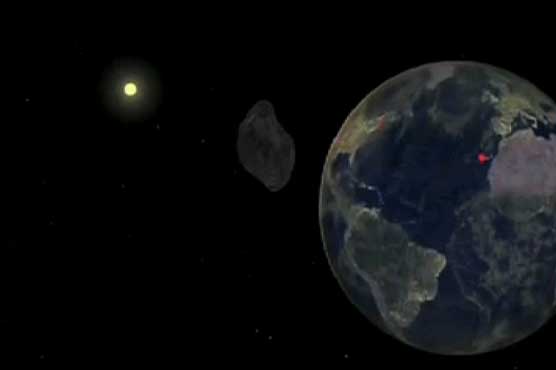
NASA says there is no chance of a crash landing when it zips past our planet. Astronomers have aimed their telescopes to catch a glimpse of the 2005 YU55 asteroid, which is about as big as an aircraft carrier but will not be visible to the naked eye, when it passes at 6:28 pm (2328 GMT).Frankly, for anybody this is going to be really hard to see. This is 100 times more dim than what the human eye can see. You need a good telescope, said NASA spokeswoman Veronica McGregor.The near-spherical, 1,300-feet (400-metre) in diameter asteroid often travels in the vicinity of Earth, Mars and Venus, but the 2011 encounter with Earth is the closest it has come for at least the last 200 years, the US space agency said.Other asteroids of this size pass by Earth frequently, though the last such event happened in 1976 and the next will not happen again until 2028 when an asteroid called 2001 WN5 will skim about halfway between the Moon and Earth.This asteroid is expected to pass a bit further away; about .85 times the distance of the Moon to the Earth, or a distance of 202,000 miles (325,000 kilometres) from the center of the Earth.The space rocks closest pass will be off the Pacific Coast of Central America, southwest of Guatemala City, as it travels in a northwesterly direction, according to McGregor.Skywatchers should be equipped with a telescope that has a minimum aperture of six to eight inches (15-20 centimetres), experts said.2005 YU55 is one of the potentially hazardous asteroids that make close approaches from time to time because their orbits either approach or intersect the orbit of the Earth, said Robert McMillan, an associate research scientist at the University of Arizona.McMillan discovered the asteroid in 2005 as part of the universitys Spacewatch Project, a solar-system-scanning group of scientists near Tucson, Arizona.However, astronomers know from analyzing the trajectory of the asteroid that it will not hit Earth this time.The asteroids next closest pass is set to take place in 2094, at a distance of 167,000 miles (269,000 kilometres), according to forecasts.