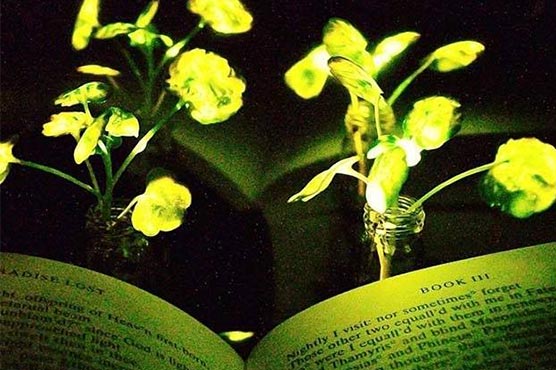
Summary The vision is to make a plant that will function as an unplugged desk lamp”, says Michael Strano.
(Web Desk) – Scientists at Massachusetts Institute of Technology (MIT) have successfully experimented to make tree-leaves exude light for hours, which can be utilised for a number of purposes, including reading and illuminating streets at night.
In an MIT lab, researchers infused kale, watercress, argula and spinach with luciferase — the enzyme that makes fireflies glow. Then they dipped the plants in a solution containing more luciferase and luciferin — the molecule that reacts with luciferase to spark the light — and applied pressure. The pressure allowed the chemical mixture to seep into the plants’ tiny pores, where the luciferase and luciferin reacted to create glow out of green leaves.
Inducing nanoparticles into the enzyme ensures it complete permeation into leaf’s pours. It goes on to prevent the chemical from making poisonous clots.
At first, the plant continued to glow for 45 minutes, but the timing was enhanced to over three hours after making some improvements.
Experts say this technology can be improved further so much so that we won’t have to rely on street lights; and, by virtue of this ‘natural lamp’, there would be no need to rely on cumbersome cable network for transmission of light.
The credit for this momentous achievement goes to MIT professor of chemical engineering, Michael Strano who says light will ultimately be powered by the energy metabolism of the plant itself.
For now, one can easily read a book under the light of a ten centimeter plant. According to experts, the plant can be made to illuminate for several more hours by improving the method. In second phase, scientist are aiming to make it easier for the user to spray nanoparticles on the leafy surface.