
Summary These inventions are expected to improve the lives of the poor and deprived classes of the society
LAHORE: (Web Desk, Daily Dunya) – It is quite true that 2016 wasn’t a great year for the world as far as politics, economy and environment is concerned but some excellent inventions have been definitely been made during the last twelve months. From a ‘flying bus’ to eatable drones, scientists brought into reality several dreams during 2016 that will shape the lives of millions of Earth’s inhabitants positively. Let’s see some of the inventions of 2016 that may help improve human lives in the years to come.
Eatable drones:
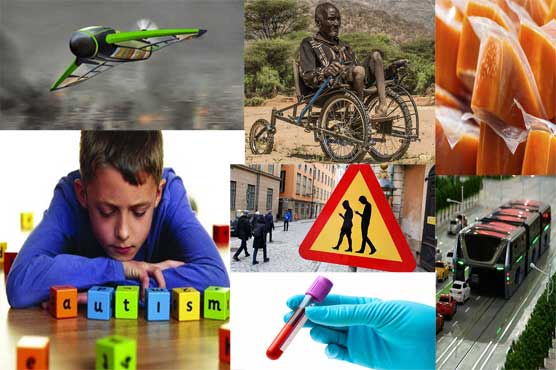
This drone is better than any other drone since it can not only be eaten but may also be able to save several lives. This cheap drone is still under the process of preparation and has been named Pouncer. The idea behind making this drone is purely humanitarian as it can be used to carry food and relief goods to those remote areas where access through road isn’t yet possible. Not only can these goods provide relief goods to remote areas but its other features, such as plywood frame, will also help people light fire. Its wings will be filled with food items and also with safety covers that may be used as tents and thus temporary homes. The drones are being prepared by a company named Wind Horse Aerospace and the company hopes that these drones will surely help the relief activities in any calamity-hit area.
The company believes that the drone will be made fully functional during 2017.
Special wheelchair for developing countries:
Wheelchairs are vital for people unable to walk but they can’t generally be used in the rural areas of the developing countries. The wheelchair named Safari Seat has been prepared especially for this purpose. It is not only cheap but durable as well. Hand-leavers and strong wheels have been attached with it so that it is easier to navigate it on uneven and rocky plain as well. It has been particularly designed for such underdeveloped areas that are deprived of proper roads. This wheelchair had been displayed in November on crowd-funded website kickstarter.com and its production is expected to begin during 2017 in Kenya.
Food packing for wrapping milk products:
Generally, plastic is used for wrapping food products and it is disposed off later, creating various environmental problems. Keeping this in view, American department of agriculture experts had decided to make such biogradable packing that was prepared with milk protein.
This packing is being considered 500 times better than plastic packing for preserving food as it keeps oxygen more effectively at bay from the food.
Artificial limbs prepared within two hours:
Artificial limbs take weeks to be made, manufacturers have to rub it for days and they cost way too much. As a matter of fact, the poor of the society are generally unable to access these artificial limbs and 80% people never obtain them.
Keeping this in view, a German company named AMPARO has prepared simple costume fitting artificial limbs called Dignity Socket. It can be reassembled into a smaller or larger limb so that the users may not feel the discomfort. What’s more is that it takes only two hours to be prepared.
Medical treatment with toys:
Autism is a disease that hinders mental growth and may appear in kids aged between 18 to 36 months. A kid suffering from this disease remains in a world of his own and aloof from the rest of the world. To make these kids an important part of the society, a company named Leka has prepared smart toys.
These interactive and multi-sensor devices are like a friend and provide confidence to the kids suffering from autism through free play. These devices keep the kids busy in various activities with the help of sounds, music, light and vibrations. They can be fitted differently for different kids in accordance with the requirement.
Reversible tents for houseless people:
One of the biggest challenges for many people across the world is inaccessibility to permanent houses due to which they are forced to fight off extreme weathers and difficult conditions. Weather Hide is a reversible tent that provides houseless people with safety from all kinds of climates. On one side of these tents are reflective panels that keep the inside of the tent cooler during extremely hot weather while the other side has been designed such that it keeps the cold out in extremely cold weather. The manufacturers of these tents had started a campaign to generate funds for these tents on kickstarter.com and they were able to raise around 150,000 US dollars.
Device alerting deaf people from threats:
If alarm goes off to highlight an alarming situation, people with hearing disability do not get alert because they cannot hear the sounds. So an American company has manufactured a small device called ‘sound sense’ which helps deaf people identifying threats, alerts and loud sounds. This device makes sounds like car horns and sirens and the deaf people are able to identify these sounds since it transmits them to their ears through vibrations. It only costs 30 dollars, which is almost nothing compared with other devices of this sort.
Cup to save newborn babies’ lives:
If a newborn baby’s mother dies and it doesn’t get the appropriate care, it not only faces malnourishment but is also exposed to the threat of death. However, a cup priced 1 dollar only may provide safety to the baby from these threats. The device called NIFTY cup is available for just one dollar and it is for those newborns that are unable to eat by themselves.
There is a small hole in the upper part of this cup where milk can be saved in reasonable quantity and it fits completely into the newborn’s mouth. It has been prepared by an organisation working worldwide for health called PATH, Washington University and Seattle Children’s Hospital.
Edible spoons:
Indian company BAKEYS has made edible spoons that can also be eaten after being used for eating food. These spoons have been made from rice and wheat so that plastic waste may be curbed. These spoons can be used up to two years after being prepared and they come in different tastes as well. Moreover, they do not melt into hot curry or soup. They had been introduced early in 2016 and the funds is currently gathering funds for their distribution.
Sidewalk traffic lights for mobile freaks:
Whether you admit or not, fact is that most of the youngsters these days are looking at their mobile phones instead of the road even when crossing the road. Keeping in view of this trend, German Public Transportation has installed lights in the streets that may allow the walkers when to walk or when to stop. The strategy was implemented in April 2016 and the department believes that it will help the walkers understand the road better even if their eyes are fixed on the mobile screens.
China’s future bus:
In May 2016, China introduced a bus that passes over the cars. The reason behind this invention was to utilise the road completely and keep it safe from traffic jams and fight the pollution at the same time. These electricity-based transit-elevated buses run on railway-like tracks and thus help the driver passing by all the cars from the above. Each bus can carry 1200 passengers and its impressive system provides cheap and rapid mass transit system.
Although these buses haven’t started working as yet and work is under progress on the design and some security measures, it is expected that they will soon be on the roads and will provide a long-term solution to China’s public transport problem.
Zika virus’ simple diagnosis:
Zika is a virus that is fast spreading across the world and has arrived in Asia as well. The research on its treatment is also underway at rapid pace. America’s MIT Institute prepared a cheap diagnosis test for the virus this year. Generally the diagnosis for a disease takes several days but according to the researchers at MIT, this new test took only three hours to diagnose Zika virus. A paper is taken on which the purple spots turn yellow when in contact with blood containing the virus. The test costs only one dollar.
Robotic spoons for disabled people:
These robotic spoons are for those who cannot move their hands easily. This device helps them eat food without moving their hands a lot. These spoons come with hi-tech sensors, computer and motors fitted in them. They can be used after being attached with a regular spoon or fork. They are extremely helpful for those with affected vertebral columns, mental paralysis, Parkinson’s disease or paralysis. It costs USD 195.
Helpful system for refugees:
United Nations’ World Food Program introduced a new system for overcoming the food shortage for the refugees in February. Under this system, food is provided to the Syrian refugees through the eye-scan. The eye-scan is required for the refugees when they are buying some commodity from the shopkeepers. They were used in various refugee camps in Jordan while it also proved more secure for the refugees compared to the electronic card system as the cards are easily misplaced, stolen and used illegally.
Facebook tool to keep users connected during calamities:
After a calamity hits a place, it is extremely difficult to look for food, water or shelter. This is true especially for the poor people. Facebook introduced the community help tool for such situations. It was announced in November through Facebook’s social good platform. Facebook believes that this tool can help poor people locate food, water, shelter and other necessary items. This feature will come to the fore when the users will check themselves as safe in a safety check after a calamity. In this way, they’ll be able to request help from the other people in their area.
The feature will be active for Facebook users from January 2017.
Environment friendly AC that works without electricity:
A project titled as echo cooler is being worked upon in entire Bangladesh where 70% of the population lives in houses made of tin. Most of these houses don’t have the electricity facility and they heat up like a furnace during the summers. This project needs just a few plastic bottles and a board. It was introduced by Grey Dhaka and Gramine Intel Social Business Ltd. The necks of all the bottles are inserted into the holes on the board and it brings the temperature dramatically down by compressing the hot air.
The story was originally published on the Sunday magaine of Daily Dunya. It was researched by Faisal Zafar.


