Updated on
Summary
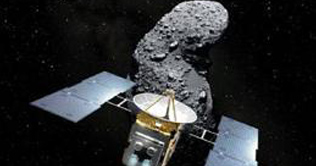
Scientists are today retrieving a Japanese space probe from the remote Australian Outback, optimistic that it will contain the first sample of asteroid dust ever brought back to earth.Seven years after it began a space odyssey that took it four billion miles through the universe, the Hayabusa explorer returend to earth with a spectacular light display early this morning as it incinerated on re-entry, after jettisoning a capsule expected to contain material that could shed light on the solar systems origin.The Hayabusa, which means peregrine falcon, was launched in 2003 to collect samples from an asteroid and bring them back to Earth for testing. It is the first spacecraft successfully to land on an asteroid and return to earth, and the first space landing in Australia. Nasa and Japanese space agency scientists waiting in the desert hope it will also be the first probe to bring asteroid dust to Earth.We just had a spectacular display out over the outback skies of South Australia, said Trevor Ireland, the only Australian scientist on the Hayabusa team. We could see the little sample return capsule separate from the main ship and lead its way in and (we) just had this magnificent display of the break up of Hayabusa, he said.The capsule parachuted to Earth within the Woomera Prohibited Area, a remote military zone the size of England 300 miles (485km) northwest Adelaide. A team of scientists from the Japanese Aerospace Exploration Agency (JAXA) and from NASA are in Woomera to recover the capsule, the Australian Science Media Centre said in a statement.After being retrieved, the basktball sized capsule will be sealed in an airtight vessel and taken to Japan for study.The Hayabusa, the $200 million project launched by the Japan Aerospace Exploration Agency (JAXA) seven years ago, landed on the Itokawa asteroid in 2005.After an unsuccessful attempt to collect samples from the 1770 foot (540m) wide potato-shaped lump orbiting 2 billion miles (3 bn km) from Earth, scientists sealed the probes sampling chamber in the hope that it might collect dust that floated up when the probe touched the asteroid.A team of American, Japanese and Australian scientists will carry out preliminary analysis on the dust. They hope it will show them how and when the asteroid was formed, its physical properties, what other bodies it may have been in contact with, and how solar wind and radiation have affected it.Hayabusa was originally due to return to Earth in 2007 but a series of technical glitches including a deterioration of its ion engines, broken control wheels, and the malfunctioning of electricity-storing batteries forced it to miss its window to maneuver into the Earths orbit until this year.Hayabusa did not just take from the asteroid. It also left a little bit of Earth behind: a metal ball wrapped in a thin plastic film that bears the names of 880,000 people from 149 countries, among them Steven Spielberg, the American film-maker, and the British science fiction author Arthur C. Clarke, who had all responded to Jaxas public invitation to be listed.