Updated on
Summary
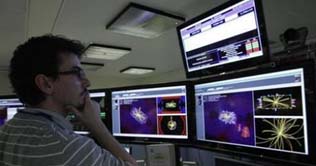
European scientists say they have successfully used the world's largest atom smasher to crash protons into each other with three times more force than ever before. The experiment aims to mimic conditions close to the Big Bang, the theoretical explosion scientists believe created the universe. Scientists at the European Organization for Nuclear Research, or CERN, called Tuesday's achievement the beginning of a new era in science. The Large Hadron Collider is designed to circulate two beams of protons in opposite directions through a vacuum as cold and empty as outer space. After overcoming some technical glitches, Tuesday's experiment sped protons into each other at nearly the speed of light (300,000 kilometers per second). The collision creates an enormous amount of heat and energy in a small area. Project leaders say the conditions simulate those present billions of years ago, a trillionth of a second after the Big Bang. Scientists hope the high-speed collisions will help them unlock mysteries about how the universe was created. The team says the machine will also let them probe the dark, or invisible, matter that makes up an estimated 25 percent of the universe. But some European and American scientists warn that the experiment could create microscopic black holes that could swallow Earth. Project leaders have dismissed those fears as ridiculous. Scientists have been working on the $10-billion atom smasher for more than 20 years. The machine is housed in a 27-kilometer underground tunnel below the Swiss-French border.