Updated on
Summary
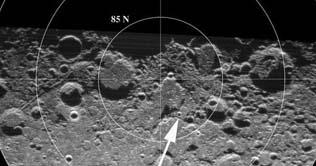
The US space agency's (Nasa) Mini-Sar experiment found more than 40 small craters containing water ice. But other compounds - such as hydrocarbons - are mixed up in lunar ice, according to new results from another lunar mission called LCROSS. The findings were presented at a major planetary science conference in Texas. The craters with ice range from 2km to 15km (one to nine miles) in diameter; how much there is depends on its thickness in each crater. But Nasa says the ice must be at least a couple of metres thick to give the signature seen by Chandrayaan-1. Dr Paul Spudis, from the Lunar and Planetary Institute in Houston, estimated there was at least 600 million metric tonnes of water ice held within these impact craters. The equivalent amount, expressed as rocket fuel, would be enough to launch one space shuttle per day for 2,200 years, he told journalists at the 41st Lunar and Planetary Science Conference. What all these craters have in common are large areas of their interiors that never see sunlight. Temperatures in some of these permanently darkened craters can drop as low as 25 Kelvin (-248C; -415F) - colder than the surface of Pluto - allowing water ice to remain stable. It is mostly pure water ice, said Dr Spudis, it could be under a few tens of centimetres of dry regolith (lunar soil). This protective layer of soil could prevent blocks of pure ice from vaporising even in some areas which are exposed to sunlight, he explained. In February, President Barack Obama cancelled the programme designed to return Americans to the Moon by 2020. However, Dr Spudis said: Now we can say with a fair degree of confidence that a sustainable human presence on the Moon is possible. It's possible using the resources we find there. The results from these missions, that we have seen in the last few months, are totally revolutionising our view of the Moon.