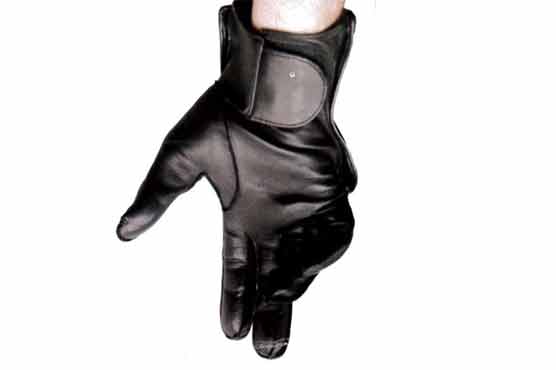
Summary “Talking” glove interprets gestures of stroke victim into words.
William Broad was left unable to speak following a stroke but can now say thank you and ask for a glass of water with the help of the glove.
Bill Broad, 73, from Sheffield, suffered a stroke in 2010 leaving him unable to speak, forcing him to spell out words on an alphabet chart when trying to communicate with his daughter Keeley Bellamy.
But now the former miner and athletics coach is first to be testing a new technology that can translate hand gestures into speech.
Sensors fitted into a leather glove he wears on his left hand can detect his hand movements, converting them into a synthesised voice. It has allowed him to tell his family when he is hungry or thirsty, to ask the time and to say “thank you”.
The device has been developed by a group of engineers who recently graduated from the University of Sheffield.
Mrs Bellamy, 41, who lives in Sheffield with her father, said: “Dad went from being such a fit miner who did athletics coaching to hardly being able to do anything after his stroke and it left him without a voice.
Stem cell treatment helps heal stroke victims 15 Jun 2012
Microsoft unveil instant translation tool 09 Nov 2012
“He had a computer for him but it was so bulky and took so long to use. In the end we started pointing at letters on an alphabet chart.
“He got the glove a few months ago and it has been brilliant. He knows about 20 phrases now, so there are quite a few combinations for him to learn but he can tell us when he wants a drink and say thank you.
“As he learns more words, we hope it will allow us to have proper, full conversations again. At the moment we often end up sitting in silence as it can quickly get frustrating trying to communicate.
“Communicating with the glove would make his life so much easier and make him a lot happier.”
The talking glove was invented by engineers Vinoth Gurasamy, Kalhana Colombage, and Hossein Mohanna as part of an enterprise competition at the University of Sheffield.
The glove, which looks like an ordinary leather glove, can be programmed to articulate more than 1,000 words. Each glove costs around £700, weighs about three ounces and has a battery that will last up to a week.
The group have now taken out a patent for the invention and are hoping to develop it further so it can be sold commercially to people who have speech disabilities.
Mr Colombage said that many people with speech problems have to rely upon large keyboards they carry around with them to communicate.
He added that the device could also be adapted to help translate sign language, but it would require far more complex computing gloves would need to be worn on each hand.
He said: “The gestures we use are quite simple – like bending a finger, or holding three fingers out with the palm up. It can translate between a few hundred to 1,000 gestures. Sign language is a lot more complicated.