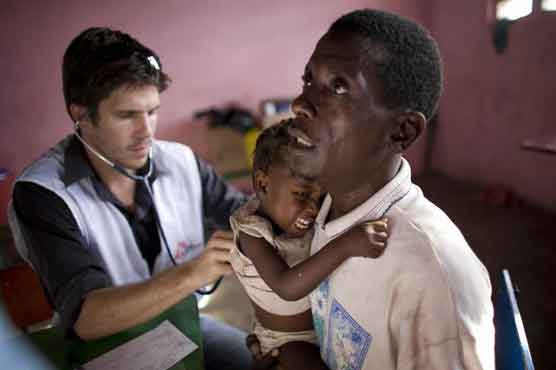
Summary The group Doctors Without Borders has aided victims of war and disease in African countries.
The countries where this humanitarian group of doctors is giving services include Sudan, Haiti and the Democratic Republic of Congo.
Now, they are on their first mission in the United States -- helping victims of Sandy, the megastorm that brought historic destruction to the New York metropolitan area.By last Saturday, medical teams were on the ground in the Rockaways, a hard-hit section of Queens, as well as Staten Island, New Jersey and Brooklyn.
The doctors, nurses and medical students provide free medical evaluations to residents still without power, and help them fill and pick up prescriptions they might otherwise go without.While noting the environment was apples and oranges compared to many of the locations Doctors Without Borders has worked, media relations manager Michael Goldfarb said there were gaps in health care after Sandy that the organization could address.
There are real needs here and were doing our best to try to meet them, he said. There are vulnerable people here.In Far Rockaway, where a crew of four doctors, one registered nurse, four medical students and several other volunteers were working from a makeshift clinic in the first-floor laundry room of an apartment building, police direct traffic because street lights have gone dark.
There are National Guard trucks on the streets, and litter left behind where floodwaters receded.Gas rationing in New York City began Friday, with drivers only able to fill up on even or odd days depending on the number at the end of their license plate -- but that was of little use here.At abandoned gas stations, cones and caution tape alerted motorists that they should move on.Candice Humphrey, 28, lives in Brooklyn and never thought the first place she would work with Doctors Without Borders would be her own backyard.
A nurse practitioner who started training with the organization in September, Humphrey is awaiting her first placement overseas.In Queens, she has provided home visit-type health care to residents in buildings such as one apartment complex that had no electricity and no running water above the fifth floor.Some residents on upper floors are essentially trapped, she said, particularly the elderly, and those with knee or back problems that make it impossible for them to walk up and down stairs.We are seeing a lot of people who are running out of their medications, Humphrey said.
People with diabetes, type 2, HIV, high cholesterol, other chronic health conditions that are not getting the medications that they normally would be taking because their supply chain has been broken.Louis Nelson, the handyman for the building where the clinic is set up, has been walking up and down the stairs to fix broken drainpipes and other building issues and figured hed stop by to have his blood pressure checked.
When New York University medical student Steffen Haider took his blood pressure and discovered it was high, Nelson said he would make an appointment with his doctor.Power is still out in apartments, and he said he had seen people lining up for the clinic.Im glad that my tenants here take advantage of it because they went through so much stress due to the hurricane, he said.Shauvan Nichols stopped by with her 9-year-old niece, Soraya, hoping to pick up medications for her elderly mother, who has diabetes and lives on the 15th floor of Nichols building across the street.
The power is still out, and her mother cant go up and down all those stairs.For people like them, its good, because theyre not walking around, Nichols said. I think its really good that the guys came over here just to help them.Nikole Russell, 64, lives in the building where the clinic is set up and has been helping direct friends and neighbors to the clinic.
She praised volunteers shed seen walk up 20 flights of stairs -- more than once -- to tend to patients on that floor.Doctors Without Borders, Red Cross, we love you, we thank you, we appreciate what you have done for all the tenants, Russell said. And what youre about to do, because youve got to come back tomorrow, too.Indias car sales jumped by 23 percent in October -- the fastest rate in nearly two years -- industry data shows, driven by greater demand during the festival season and a slew of new model launches.Some 172,459 cars were sold in October, up 23.1 percent from the same month a year earlier, according to a Society of Indian Automobile Manufacturers (SIAM) report.
]The rate we have seen in October is the best since January 2011 when we had 25 percent growth, SIAM director general Vishnu Mathur said.SIAM recently slashed its projected car sales growth for the financial year to March 2013 to between one and three percent from an earlier 10 to 12 percent forecast due to the economic slowdown, higher import tariffs and labour trouble at the countrys biggest passenger carmaker Maruti Suzuki.
Mathur said seasonal factors helped spur the October rise -- the religious holidays are seen as an auspicious time to buy in India, along with a raft of new models rolling off assembly lines.But he said the real test of the auto sectors health -- regarded as an important barometer of overall economic performance -- will come once the festival season was over.India has been one of the worlds fastest-growing car markets in recent years
.But it has been suffering a slowdown in demand as some buyers defer purchases due to expensive loans, high fuel costs and a downturn in economic growth that is making consumers wary of making big-ticket purchases.
The next months will be very important (to the auto outlook), Mathur said, citing still high interest rates to counter stubbornly high inflation that has kept borrowing costs elevated as well as the overall economic weakness.Indias market outlook is of vital importance to global automakers from GM to Toyota, which have been steering to India and China with their billion-plus populations to boost sales and counter sluggish demand in developed nations.