Summary Every match in the 2026 FIFA World Cup will use a ball made by Sialkot’s skilled workers
(Web Desk) - When the FIFA World Cup 2026 kicks off across Mexico, the US and Canada, every pass, shot and goal will carry a quiet link to Pakistan.
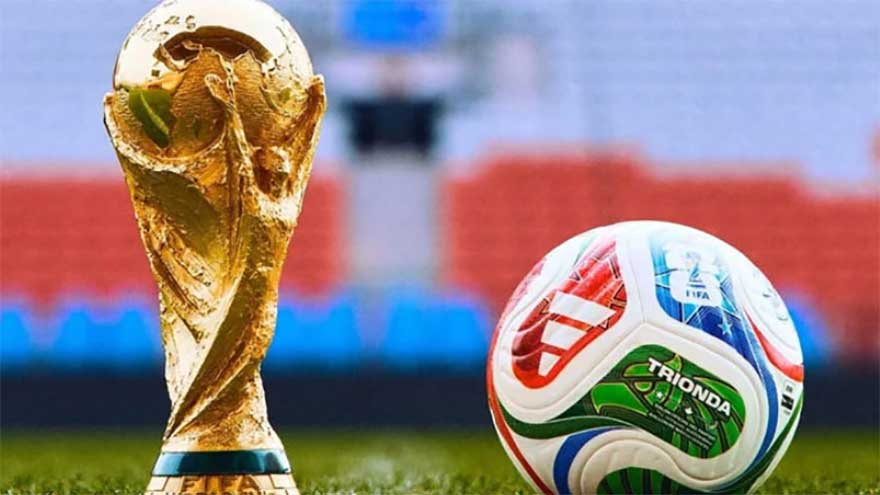
The tournament’s official match ball, the Adidas Trionda, is being manufactured in Sialkot.
In fact, if you own a football, chances are it was made in this city. Sialkot supplies more than two-thirds of the world’s footballs, with its skilled workers hand-stitching panels in local factories. For decades, the city has been at the heart of global football manufacturing, including the production of balls used in the sport’s biggest tournaments.
Despite Pakistan never having qualified for a FIFA World Cup, the country has played a behind-the-scenes role in the tournament for decades through Sialkot's football manufacturing industry, producing official match balls used on football's biggest stage.
Adidas introduced the Trionda as the official ball for the expanded 48-team tournament. It features advanced technology and a design inspired by the World Cup’s three host countries. Adidas says the ball uses Connected Ball Technology, which gives real-time data to match officials and works with the semi-automated offside system.
WHAT DOES ‘TRIONDA’ MEAN?
The name "Trionda" pays tribute to the tournament's unique format. According to Adidas, it combines "Tri" for the three host countries and "Onda," the Spanish word for wave, meaning “three waves.” The name symbolizes the unity of the United States, Canada, and Mexico as hosts, and reflects the movement and rhythm of the game.
The ball features a red, green, and blue color scheme honoring the three host countries. Its new four-panel construction with fluid geometry echoes the waves in its name.
The panels form a central triangle, representing the union of the host nations. Iconography includes a maple leaf for Canada, an eagle for Mexico, and a star for the United States. Gold embellishments reference the FIFA World Cup Trophy, highlighting the tournament's significance.
SOPHISTICATED TECHNOLOGY
The Adidas Trionda brings new features for better performance. Its four-panel design has deep seams that help the ball stay stable in the air by spreading out drag evenly.
Embossed details on the surface improve grip, making it easier to control, even in wet or humid weather.
The ball also has connected-ball technology and a precise 500Hz motion-sensor chip inside. This allows real-time tracking of the ball’s movement and sends accurate data to the video assistant referee system.
The technology helps officials make faster, more accurate decisions, especially on close offside calls.
WORLD CUP AND SIALKOT'S DECADE-LONG HISTORY
Although the Trionda has Adidas branding, it starts its journey in Sialkot, Pakistan’s main city for sports manufacturing. Sialkot is known worldwide for making both hand-stitched and thermally bonded footballs.
Forward Sports, a company based in the city, is responsible for making the 2026 World Cup ball.
Forward Sports is experienced with major football events. The Sialkot company has made several official Adidas match balls before, such as the Brazuca for Brazil 2014, the Telstar 18 for Russia 2018, and Al Rihla for Qatar 2022.
The Trionda continues its long partnership with global football organisations.
Sialkot has been connected to the World Cup for many years. Its factories have produced balls for professional clubs, international tournaments, and top sports brands worldwide.
Thanks to its skilled workers and large-scale production, Pakistan plays a major role in the global football supply chain, even if this is not always widely known.
For Pakistan, the Trionda is more than just another contract. It highlights the country’s ongoing role in world football, even though it does not have a team in the tournament.
Every match in the 2026 FIFA World Cup will use a ball made by Sialkot’s skilled workers.