Summary Conflicts over land rocked the Afghan city where he lived with his adoptive parents.
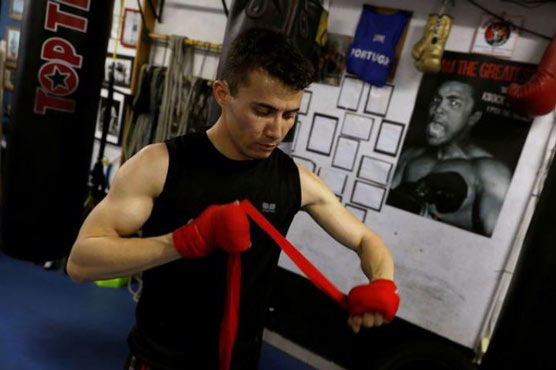
(Reuters) - A young Afghan refugee living in Portugal is attempting to achieve in 10 months what normally takes years of preparation - qualifying to box in the Olympics.
But 22-year-old Farid Walizadeh, who faces his first international qualification challenge next month ahead of the Tokyo 2020 games, is no stranger to uphill struggles.
At the age of seven, he fled his hometown in northeastern Afghanistan, travelling more than 2,500 km (1,550 miles), mostly on foot, to Turkey. There he was arrested on arrival after smugglers he had met on the way loaded him up with a backpack they said contained sugar but was in fact filled with drugs.
"I didn’t have the choice [but] to leave, because I didn’t have family or a house. Everything was destroyed. So I left Afghanistan," he said, speaking in English.
Farid’s mother had fled religious persecution to Pakistan. His father was in the military. Conflicts over land rocked the Afghan city where he lived with his adoptive parents.
"I started with more than 200 people from Afghanistan until Pakistan. During the way, it was hard in the mountains of Afghanistan, it’s totally dry and cold, so each time the group becomes smaller," he said.
After entering Pakistan, he tumbled off the back of a truck and continued alone to the Iranian-Turkish border.
Housed in an orphanage in Istanbul, the nine-year-old began practicing kung-fu and taekwondo to defend himself from bullies.
"I had no protection from the boys on the street, in school," he said, adding that they didn’t like refugees.
After five years in Istanbul, the UN Refugee Agency relocated him to Portugal, where he was taken in by a non-profit organisation in Lisbon for unaccompanied minors seeking asylum.
"The only thing I knew was Cristiano Ronaldo was from Portugal, so I said I’m going to go there and try a new life," he smiled.
He started martial arts again, this time trying boxing. After five months, he rose to become the national cadet boxing champion, also winning a Human Rights Prize from Portugal’s parliament.
But as a refugee without Portuguese nationality, his career opportunities were limited.
In 2015, the International Olympic Committee (IOC) created the world’s first Refugee Olympic Team for the Rio 2016 games.
Farid, then 18, was in no condition to compete. He worked nights in a hotel and studied during the day to achieve his second big dream in life: becoming an architect.
But Portugal’s Olympic Committee had its eye on him, and last March he received a scholarship from the IOC to train full-time for the 2020 games that begin in July.
Farid’s coach Paulo Seco, who has sent various Portuguese boxers to the Olympics, is blunt about the challenge Farid faces: "This type of work isn’t done in ten months, not even close.. He’s leaving his blood here for it."
Farid will compete in a qualifying tournament for European athletes in London next month in his bid to represent the Refugee Olympic Team, to be followed by a world tournament in Paris in May.
"I work hard," he said. "I want to inspire people there’s always a second chance if they want it... That’s why I want to go to the Olympics. If I can do it, they can do it."