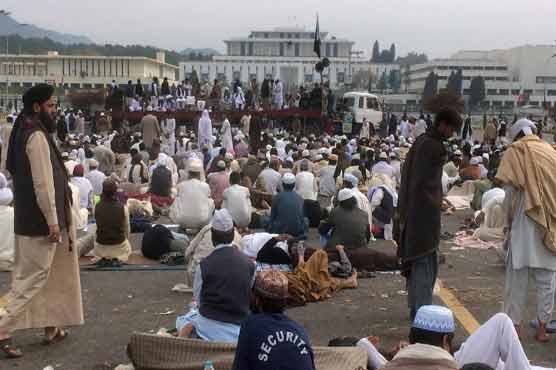
Summary 1100 demonstrators were arrested for creating unrest in Islamabad and destroying public properties
Dunya News Report (Talha Ul Huda)
On 27th March 2016, a supposedly peaceful protest against the execution of the controversially acclaimed assassin of the Governor of Punjab was to be staged in the Capital city. As soon as a congregation of around 10,000 clerics and madrassah students entered the capital, in an almost instantaneous outburst, the crowd started destroying public properties and attacking citizens. These acts of vandalism were met with a cautious approach by the capital police and the hoard was given warnings to exit the capital territory. The angry mob proceeded towards the red-zone, retaliating to which the capital police administered the use of tear gas and arrested several demonstrators.
Supportive parties from the adjoining city of Rawalpindi rushed to the scene to aid the demonstrators. To cut off this pour-in, the Capital authorities set up blockades between the main routes connecting the two cities.
Cellular services were also suspended in the capital territory to cut-off communication and to avoid any external miscreants seeking benefit from this assemblage.
These riots held dire consequences for the administrative authorities of the Capital; an estimated Rs 150 Million worth of damages was caused to the public properties, including the destruction of the Parade ground metro bus station, which was completely ransacked by these demonstrators. According to the Punjab Metrobus Authority (PMA), a total of 100,558 commuters were affected as the bus service remained closed throughout the riots. An estimate of Rs 2 million of loss was recorded due to the suspension of the public service by the PMA.
On the second day of the riots, the crowd diminished considerably and was reduced to 2000 activists. 1100 individuals were arrested and transferred to prisons outside the twin-cities. Sources site that the police officials deemed it unsafe for these culprits to be held at Adiyala or any prison within the confinements of the twin cities.
At a gradual pace, the procession took form of a sit-in in front of the infamous D-Chowk, which has a history of hosting some of the largest protests in Pakistan’s history. On the same day, a demand draft was prepared by the various religious leaders backing this movement. A second-tier fore-runner of the Pakistan Sunni Tehreek requested specifically that the National Assembly Speaker Ayaz Sadiq and the federal minister for finance Ishaq Dar be the mediators. This demand draft majorly constitutes the freedom of some detained religious offenders, and the execution of the alleged blasphemer Asia Bibi. This draft also includes the declaration of a national holiday after the cause of these riots; Mumtaz Qadri.
In congruence to these riots, demonstrations in Karachi were also observed. Consequently, some of the main inter-connecting routes and corridors of the city were blocked and traffic was held up which caused inconvenience to the general public. In a reported incident, the Qadri activists turned hostile and assaulted a few journalists in an ambush at the Karachi press club. A private-channel’s vehicle was set ablaze and other property was damaged. Several demonstrators were arrested for these acts of vandalism and unrest.
The interior Minister Chaudhry Nisar called upon the press on the evening of March 29th. He brief the media about the state of affairs at D-chowk and expressed his gratitude to the press for not propagating the situation. He said that use of force had been avoided to spare any unnecessary fatalities or injuries. But the red-zone is to be cleared out at all costs, as an assemblage of this nature poses a threat to the security situation. He said that 7,000 police personnel are on stand-by, awaiting the final attempts at negotiations, after which all possible means will be administered to remove these rioters from the capital. The Minister also said that the capital will not be held hostage again and inquiries will be made to find out as to how these miscreants entered Islamabad in the first place.
Various analysts have offered speculations as to what the actual agenda behind this unrest might be; some analysts are of the opinion that this commotion might be financially backed up by the Indian intelligence agencies to provide a public cover to the recent capture of the RAW agent, Commander Yadav. Experts believe that this might be an attempt to provide a distraction to the administration and the general public, while an escape plan is devised for the agent, or negotiations are held to extract him.
Another theory put forward by various senior journalists and analysts is that some individuals blended in the clerical mob might be using Mumtaz Qadri as an incentive to put forward their own long-standing unilateral demands. The theory elaborates into the conjecture that a select few opportunists might be using the aggressed religious hoard to their advantage, manipulating the situation to fuel their own agendas. A suggestion was also made that these events might be a discreet political show of power by the opposing parties.