Summary Islamabad to host first round of peace-talks between Afghan Govt. and Taliban in 1st week of March.
Dunya News Report (Madiha Fareed)
KABUL-Islamabad will host first round of direct peace talks between Afghan government and Taliban groups in the first week of March 2016, announced a joint press release issued by the Afghan Foreign Ministry at the event of 4th meeting of the Quadrilateral Coordination Group (QCG) held here on Tuesday.
The QCG invited Taliban and other groups to participate in the direct talks with Afghan Government through their authorized representatives. However no mention was made as to which Taliban groups have agreed to take part in the talks.
Speaking to the inaugural session of the meeting, Afghan Foreign Minister Salahuddin Rabbani urged Taliban factions, Hezb-i-Islmai in Particular, to join the talks; and according to the sources, Hezb-i-Islmai is seriously considering to join the talks.
Building on the progress on first three meetings, the 4th round of Quadrilateral Coordination expressed staunch support for upcoming direct talks. It was reported that a roadmap for the talks between Afghan Government and Taliban Groups had been finalized in the third meeting of QCG held on February 6th in Islamabad. It was also reported that Pakistan had presented a list of Taliban willing to negotiate. Previously, The QCG had strongly insisted that no preconditions be attached to the peace-talks.
The QCG, consisting of top diplomats from four nations (Pakistan, Afghanistan, China and United States of America), was established with the mandate to chalk out a viable framework for peace dialogue between Afghan government and Taliban for lasting peace in Afghanistan.
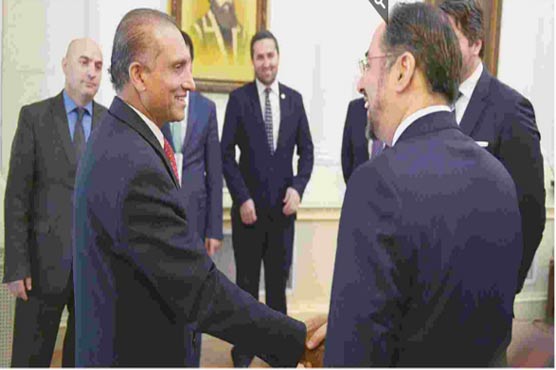
Foreign Secretary Aizaz Ahmed represented Pakistan in the QCG meeting. While Afghan Deputy Foreign Secretary Hekmat Khalil Karzai, Chinese Ambassador Yao Jing and US Charge d’Affairs David Lindwall led their respective sides at the meeting.
The QCG hailed President Ashraf Ghani’s strong commitment to bring Peace through negotiation. It also welcomed the decision by Afghanistan and Pakistan to constitute a bilateral joint working group to work with the Ulema of Afghanistan and Pakistan for their support to the peace and reconciliation process in Afghanistan.
On Monday Pakistan’s Chief of Army Staff (COAS) General Raheel Sharif made a one-day trip to Qatar and held meetings with top Qatari leadership including Ameer of Qatar in an attempt to smooth out the rough edges obstructing the peace-process in Afghanistan and to lobby in order to engage Taliban’s Qatar political office in the peace talks.
Pakistan brokered “Murree Talks”, held from July 7-8 last year, were the first direct official talks between Afghan government and Taliban. Afghan government and Taliban representatives came face to face for the first time to discuss the possibility of a political settlement. Other stakeholders present at the talks included representatives from China and the United States. Washington lauded Pakistan’s role for arranging these historic talks and expressed hope that the reconciliation process will bring stability to the region and Secretary General United Nations also appreciated the initiative. However the optimism was short lived as the second round of talks - scheduled for July 31- was suspended when the news of Taliban Commander Mullah Umar’s death surfaced on the media. Subsequently a new Taliban leadership took over with Mullah Akhtar Mansour as their new commander. The talks were never resumed.
Despite Ashraf Ghani’s urging for Pakistan to take a center stage regarding Peace-process in Afghanistan, Pakistan has cautiously maintained that “It is an Afghan-led and Afghan-owned peace initiative”, and Pakistan will only “facilitate” the process.
Taliban leaders; had opted for a hard-line stance ahead of the first meeting of QCG saying no to any kind of dialogue. Earlier, reports had claimed that Sirajjudin Haqqani could be one of the Taliban leaders to take part in the peace talks; but the reports were later dismissed by Taliban sources as baseless and reiterated that no representative of Taliban will join the talks. The Taliban officials blatantly dismissed any possibility to sit with what they call “powerless Kabul Administration”, and view it as illegitimate and a puppet of foreign powers.
The formation of QCG and the steady progress it has made so far has reignited the hopes of bringing the stalled Afghan Peace Process back on track and has brightened the prospects of a political settlement between the main players of Afghanistan’s decades long civil war which has ruined the country’s infrastructure and has made the life of its citizens a living hell.
The next meeting of QCG will take place in Islamabad immediately after the first round of direct peace talks.