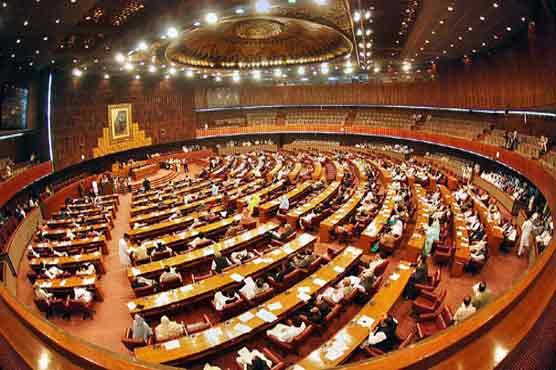
Summary Members of ruling party show a lack of interest as the quorum is pointed out often.
Dunya News Report (Madiha Fareed)
ISLAMABAD- Prime Minister Nawaz Sharif has a terrible record when it comes to his attendance in Parliament. He has only attended 36 out of 256 sittings of the National Assembly, a FAFEN (Free and Fair Election Network) report revealed.
28 sessions have been held so far of the 14th constituent assembly. Out of which, PM Sharif did not attend even a single sitting of 11 sessions including 4th, 5th, 6th, 7th, 10th, 16th, 18th, 19th, 21st, 27th and 28th session.
In his first year, Nawaz Sharif attended parliament for only seven days. However the numbers magically improved during the hundred days of-Pakistan Tehreek-e-Insaf’s anti-government sit-in. The Prime Minister was present in 17 out of 19 sittings of the six joint sessions held during the “dharna”. But as soon as the dust settled, the prime minister vanished again.
Opposition Leader Khursheed Shah brought the PM Sharif under heavy vilification for having an attitude of a monarch rather than of a democratically elected Prime Minister. Adding that in a democracy, a public representative is accountable to the people who elected him.
Lately, the Pakistan People’s Party Parliamentarian (PPP) proposed an amendment to the National Assembly’s rules that would have made it mandatory for the prime minister to attend parliament once a week and answer the members queries, just like the British parliament where every Wednesday the Prime Minister goes to the Parliament and answer lawmakers’ questions. But the motion was emphatically rejected by the ruling PML-N’s majority on the basis that prime minister already has so much stuff on hands since he has to “deal with a range of administrative issues”.
Opposition members expressed fury on Pakistan Muslim League-Nawaz majority parliament’s rejection of the motion and accused them for being mere sycophants who serve at PM’s pleasure.
In a parliamentary form of government, Prime Minister is the Leader of the House, and if the Prime Minister does not pay heed to what the parliament is debating about, it is a point to consider where the decisions are being made. It also raises the question that why PML-N’s lawmakers are creating hindrances towards the steps that would empower parliament.
Other than that, each session of parliament costs a lot of taxpayers’ money, and if nothing good is coming out of it and all decisions are made in closed rooms then what is point of spending so much money.
This perpetual absence reflects a lack of significance in parliamentary debates. It makes one wonder how the Leader of the House approves the legislations that he apparently knows so little about. It gives the impression that Prime Minister will take whatever decision he wants and consult whomever he wishes, without paying any attention to what the elected representatives are debating about. Had the resolution brought by the PPP been accepted, it would not only have helped bring the prime minister to the parliament, it would have also been a stepping stone in promoting a culture of accountability for the office itself and guaranteed that all future heads of government respect the parliament that brings them to power.
Pakistan Tehreek-Insaf Chief Imran Khan has a poor attendance record as well; he is among the members who are seen in the parliament once in a blue moon. In a recent interview with Moeed Pirzada, he defended himself by saying that there’s no point in going there as parliament is of trivial importance and the debates are nothing but hoaxes as all the decisions are made out of the parliament.
Opposition leader Khursheed Shah has a 77 percent attendance record; he has attended 196 out of 256 sittings and has missed only 2 sessions of the parliament. Overall, the members of both opposition parties have better records than the ruling party’s MPs.
Other than Prime Minister, the members of ruling party also show a lack of interest as the treasury benches are usually seen empty, and often quorum is pointed out by the opposition members.