Summary Eight suspects of the Safoora bus carnage case handed over to the military court.
Dunya News Report (Humaira Sajid)
KARACHI- Jail authorities on Wednesday, Jan 12 informed an antiterrorism court that eight suspects of the Safoora Goth bus carnage case were handed over to the military authorities for their trial in military authorities.
This is the first time that suspected global organization terrorists, Islamic State (IS) have been handed over to the army.
The suspects involved are highly educated some are even PHd qualified and the rest have reputable jobs. Saad Aziz alias Tin Tin, is a business graduate from Institute of Business Administration, Tahir Hussain alias Minhas construction entrepreneur, Asadur Rehman alias Malik is a call centre agent, Azhar Ishrat, an electronics engineer from Sir Syed University of Engineering and Technology, Hafiz Nasir is a post-graduate degree holder, Sultan Qamar Siddiqui former Fishermen Cooperative Housing Society vice-chairperson and Naeem Sajid alias Peena deals in weapons.
On November 22, Antiterrorism court (ATC) summoned a challan on Safoora carnage and late in December the federal government approved the trial against the suspects in special courts following the 21st Constitutional Amendment.
It is pertinent to mention here that eight gunmen had attacked a bus travelling in Safoora Goth on May 13, 2015, leaving 46 people dead, most of them were of Ismaili community. According to Sindh Police Inspector General (IG) the shooting was planned by a 25-member gang. He said that Saad Aziz had been working for terror outfit Islamic State of Iraq and Syria (ISIS) for past one year while adding that the group was making a plan for a long time.
About their fate, the authorities say that the proceedings in these cases will only be carried out once the military court has completed the current trial. “They [the suspects] may not be released from there [military s custody] and returned to this prison [central jail] after the completion of trial before Special Military Court…,” read a letter issued to the courts.
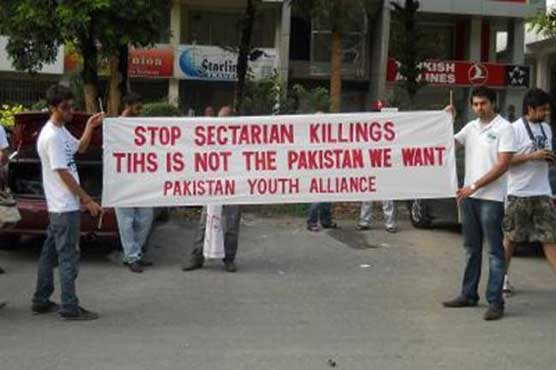
Though terrorist formations have cited different reasons for these attacks, the reality is that the Shias in particular and all religious minorities in general, are under relentless attack across Pakistan. Member Pakistan Ex-Servicemen Association Brig. (retired) Masud-ul-Hassan said that there were ‘foreign elements’ behind these sectarian killings.
“CIA has been providing funds to various sectarian groups to create unrest in the country.
“Once a civil war ensues, USA will force Pakistan to handover its nuclear assets,” he alleged.
“USA also wants to stop westward expansion of Chinese influence, and for that, it is using India. Earlier in the 70s and 80s, US used to support Pakistan to resolve the issue of Kashmir, but now it is suggesting that Pakistan should simply give up the issue,” he said.
On January 30, 2015, at least 61 Shias were killed and more than 50 were injured in a bomb attack on Karbala-e-Moalla Imambargah in the Lakhidar area of Shikarpur District in Sindh. More than 300 worshippers were inside the double-storey compound of the Imambargah and the prayer leader, Maulvi Tanveer Hussain Shah, was delivering the Friday sermon, when the bomb exploded. Ahmed Marwat of Jundullah declared: “We claim responsibility for attack on Shias in Shikarpur very happily. Our target was the Shia community… They are our enemies.”
According to the United States (US) Commission on International Religious Freedom (USCIRF) report titled “Violence towards Religious Communities in Pakistan”, published in August 2014, over the one-year period from July 2013 to June 2014, at least 430 people were killed in a total 122 attacks against minorities. These include 222 Shias in 54 attacks; 128 Christians in 22 recorded incidents; 10 Ahmadis in 10 such attacks; and two Sikhs in three attacks. Four attacks were recorded on the Hindu community in this period, with no fatality reported. 29 attacks resulted in 68 fatalities among other religious/sectarian groups.
While responding to a question, Brigadier Masud –ul-Hasan said it was not easy to resolve the issue of sectarianism.
“The fate of the country is now in the hands of the nation. People should understand that Pakistan can only develop if there is peace and unity among its citizens who belong to various schools of thoughts,” he said.