Updated on
Summary Cameron Munter has said Pak-US intelligence cooperation could be affected after Pashas retirement.
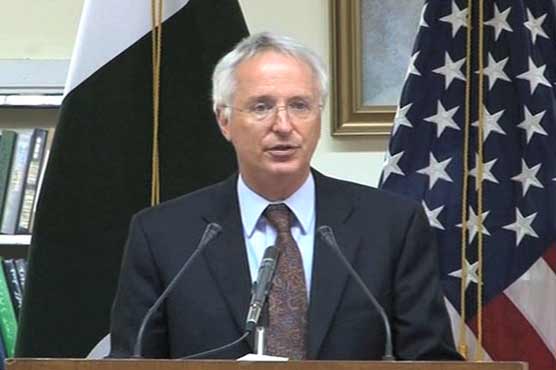
The US envoy to Pakistan Cameron Munter has said that the military-to-military cooperation with Pakistan has taken a nosedive with back-to-back during the last year or so. The intelligence cooperation, though good at the moment, could also be affected after ISI Chief, Gen. Pasha’s retirement in March this year. “The CIA-ISI relationship is still cooperative. The Pakistani government realizes that we have a lot in common on counter-terrorism and we still have a decent relationship with the intelligence. But this may change when Pakistan’s DG ISI, Lt. Gen. Ahmad Shuja Pasha retires, predicted to be around March 18”, Munter pointed out. While addressing at the Harvard-Kennedy School of Government at Harvard University in Boston, he agreed that the “military-to-military relationship has taken a beating (referring to army chief Gen. Ashfaq Parvez Kayani decision to oust US personnel after May 2)”.“When military aid was limited because of the incident, I told Gen. Kayani ‘when trainers go, equipment has to go too’. If you get rid of the boys, then you have to get rid of the toys”, Munter said. “Gen. Kayani said, ‘I understand’.” Munter revealed.“Still, Pakistan has shown its commitment to fighting terrorism”, he appreciated while informing the audience that Pakistan had experienced huge losses fighting insurgents at its own borders — nearly 4,000 troops and between 30,000 and 40,000 civilians.“In any other country this would be called a civil war. It causes a fair amount of resentment in Pakistan, and we would be wise to remember what it is that they’ve lost”, he advised.Recalling the events in 2011, he agreed that the previous year was a very tough year for the United States in Pakistan. “In the beginning of 2011, the arrest and negotiated release of Raymond Davis, an American CIA contractor, caused bad blood on both sides” he pointed out.“Two months later, an American drone strike killed nearly 50 people in North Waziristan. And not least of all, the killing of Osama bin Laden by American troops in Islamabad last May was taken as an insult to the Pakistani military”, he observed.He believed that “current strain in the US relationship with Pakistan is in part the result of a wave of idealism in the US government in 2008.“The US leaders at that time over-promised extensive commitments to Pakistan, aiming to strengthen the two countries’ relations. But those assurances backfired when American leaders failed to deliver on their promises”, he regretted.“In this relationship, neither side is blameless”, he pointed out while calling for a “more modest relationship with Pakistan, less extensive involvement in Pakistan’s affairs and less bluster in the dialogue between the two nations”.“The only way to get past a relationship that’s fraught with anger and misunderstanding is to create a partnership. You have to get as far away as you can from an assistance-based relationship”, he suggested. He hoped that the “assistance relationship currently existing will turn into a bilateral partnership in areas like trade, business, and investment in Pakistan.He was optimistic about the future of Pak-US relationship though. “If we’re going to get out of what has been a very tough period, it is going to be because both countries decide they’re going to look at something bigger than themselves”, he maintained.“The bad news is that America is unpopular in Pakistan, with a public favorability rating of roughly 6 to 10 percent. The good news, however, is that the Pakistanis care desperately what America thinks”, the US ambassador stated through his experiences in the country.“They want desperately for Americans to do good things in Pakistan, and want to see us live up to their image of what they think Americans can do”, he opined while adding that “deep down, Pakistani politicians do not want Americans to go away”.Referring to the ongoing parliamentary review in Pakistan of the relationship with US, he said the Pakistanis wanted a partnership and a better sense of respect. “We need to expand to get them out of a certain narrative they have created about the US, and we have to be less arrogant”, Munter advised.Munter’s talk kicked-off the South Asia Week at the Harvard-Kennedy School, a discussion series on the region’s politics and diplomacy hosted by the Belfer Center for Science and International Affairs Future of Diplomacy Project and Harvard University’s South Asia Initiative.The School will also host lectures by Shyam Saran, former Indian foreign secretary (Feb. 15), Zalmay Khalilzad, former US ambassador to the United Nations, Iraq and Afghanistan (Feb. 16), and Nirupama Rao, Indian ambassador to the United States (Feb. 17).- Contributed by Awais Saleem, Dunya News correspondent in Washington, DC