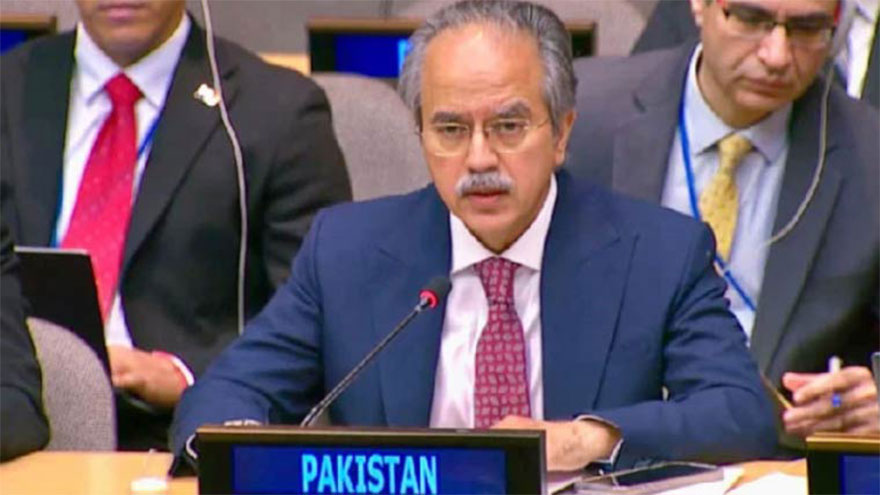
Summary Pakistan's Permanent Representative to the United Nations Asim Iftikhar said that immediate action is essential to achieve humanitarian, political, and economic solutions to the Yemen crisis
NEW YORK (Dunya News) - Pakistan's Permanent Representative to the United Nations Asim Iftikhar on Wednesday said that immediate humanitarian assistance and united global efforts are essential to resolve the Yemen crisis.
Speaking at the United Nations, Pakistani envoy Asim Iftikhar stated that urgent attention to political and humanitarian aspects is necessary. Pakistan has appealed to protect the people of Yemen from hunger, disease, and displacement.
Asim Iftikhar said that there is no military solution of Yemen crisis and added that only diplomacy and a peace roadmap can be effective. He emphasized that the international community needs to provide swift and coordinated assistance, and Pakistan advises all parties to follow the United Nations peace roadmap.
He stated that immediate action is essential to achieve humanitarian, political, and economic solutions to the Yemen crisis.
Reuters adds: A dispute over territorial control in southern Yemen has set erstwhile Gulf allies Saudi Arabia and the United Arab Emirates against each other and fractured the coalition fighting the Iran-backed Houthis.
The separatist Southern Transitional Council, backed by the UAE, seized swathes of territory across southern and eastern Yemen last month but it has mostly been retaken by Saudi-backed fighters.
Yemen, situated between Saudi Arabia and an important shipping route on the Red Sea, was split between a northern state with its capital in Sanaa and a southern state with its capital in Aden until 1990.
North Yemen, the heartland of an ancient kingdom, had gained independence from the Ottoman Empire. Communist South Yemen had been part of the British Empire until the 1960s.
South Yemen agreed unification with the north after factional infighting in 1986, and as its main financial patron the Soviet Union collapsed.
After unification the north dominated and the south tried to secede, leading to a brief war in 1994 that was quickly won by the north.
Meanwhile in the north the Houthi group emerged in the late 1990s fighting the government over what they saw as marginalisation of their Zaydi Shi'ite sect.
After Arab Spring protests erupted in 2011, Yemen's army fell apart and Gulf countries backed a transition with an interim government in Sanaa.
The Houthis captured Sanaa in late 2014 and the interim government fled south in 2015 with a Saudi-led coalition intervening on its behalf against the Houthis, triggering years of civil war.