
Summary Pakistan urged Russia and Ukraine to engage in 'structured dialogue to end ongoing conflict, emphasizing peace and diplomacy. The UN highlighted the dire humanitarian toll and called for ceasefire.
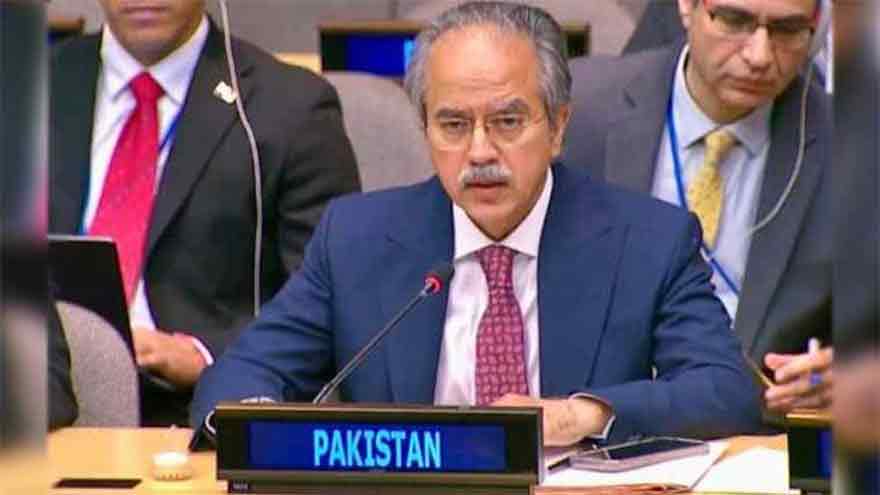
NEW YORK (APP) - Pakistan has urged Russia and Ukraine to enter into a “sustained, meaningful and structured dialogue” to resolve their raging conflict which will mark the four-year anniversary next month.
“The international community has been deeply perturbed by the continuing, and relentless hostilities, leaving behind a trail of death, destruction, economic losses and immense human suffering,” Ambassador Asim Iftikhar Ahmad, permanent representative of Pakistan to the United Nations, told the UN Security Council on Monday.
(The conflict began when Russia invaded Ukraine in February 2022, arguing it was a “special military operation” for Ukraine’s “demilitarization”, protecting Russian speakers from “genocide,” and preventing NATO expansion.)
“We are alarmed by the recent intensification in fighting with escalation in attacks from both sides, further worsening the already dire humanitarian situation.” the Pakistani envoy said in a debate in the situation in Ukraine, warning that such actions not only perpetuate the conflict, they also undermine trust, and the ongoing efforts for peace.
From the outset, he said, Pakistan’s position has been that dialogue was the only viable path for lasting peace.
“Now, more than ever before, the overwhelming global opinion is on the side of ending this conflict through peaceful means,” Ambassador Asim Ahmad pointed out.
“Diplomacy and genuine engagement in the past have delivered – as we saw in the case of Black Sea Grain Initiative in July 2022,” he said, referring to other actions, including Security Council resolutions seeking a peaceful end to the conflict.
Ambassador Asim Ahmad especially commended the efforts by many countries, particularly the United States, for the resolution of this conflict, giving primacy to dialogue.
“We hope that all sides would make full use of the ongoing diplomacy, demonstrate genuine political will, and engage constructively to make meaningful strides towards a peaceful and negotiated settlement of the conflict, starting with an immediate ceasefire,” leading to peace and security in Europe.
“The imperative to deliver millions from agony must remain paramount,” the Pakistani envoy said.
Pakistan, he added, supports all efforts aimed at resolving the issue peacefully, in a comprehensive and durable manner.
Opening the debate, Rosemary DiCarlo, Under-Secretary-General for Political and Peacebuilding Affairs, said, “The start of the new year has brought no peace or even respite to Ukraine.”
She said large-scale aerial assaults by the Russian Federation against civilians and civilian infrastructure have resulted in “horrific” levels of destruction and suffering.
Between 8-9 January, Moscow reportedly launched 242 drones and 36 missiles against Ukraine, the senior UN official said, adding that at least 4 people were reportedly killed and 25 injured in Kyiv alone.
Areas in Lviv, meanwhile, were reportedly targeted by the so-called Oreshnik, believed to be capable of carrying nuclear weapons.
DiCarlo reaffirmed the the UN Secretary-General’s calls for an immediate, full and unconditional ceasefire. “Any peace in Ukraine must fully uphold the sovereignty, independence and territorial integrity of Ukraine within its internationally recognized borders.”
Ramesh Rajasingham, Head of the Geneva Office for the Coordination of Humanitarian Affairs (OCHA) and Director of the Humanitarian Sector Division, said in Ukraine, “the plight of civilians has grown more desperate”.
Speaking on behalf of Emergency Relief Coordinator Tom Fletcher, he said the World Health Organization (WHO) has reported 11 attacks on health care in Ukraine since the start of the year.
“Each damaged substation, heating pipeline or pumping station triggers cascading failures that put even more lives at risk”.
“Use your voice, your influence and your engagement” to ensure civilians are protected, that safe, unimpeded humanitarian access is facilitated to civilians and that humanitarian action is funded in line with the scale of needs, Rajasingham said.
“Civilians who are enduring these attacks need more than statements of concern,” he added.
On his part, Russia’s UN Ambassador Vasily Nebenzya stated that the Russian army had struck transport, airport and energy infrastructure that sustained Ukraine’s “military industrial complex”. This was in response to an attack waged by the “Kyiv regime” on the the Russian President’s residence in the Novgorod region.
He denounced assertions about Russian attacks targeting Ukrainian families, insisting: “The Russian armed forces do not strike civilians.”