Updated on
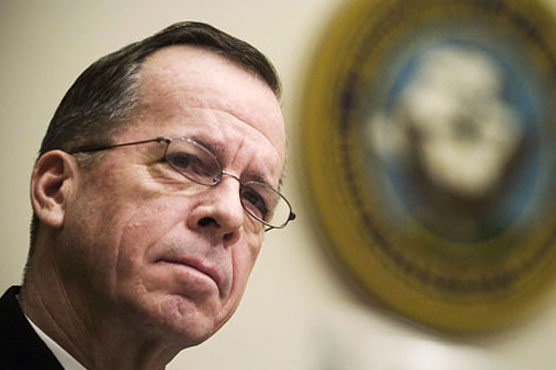
Summary Admiral Mike Mullen has blamed again that the ISI has links with the Haqqani network.
The US Chairman Joint Chiefs of Staff Admiral Mike Mullen, again has blamed that the Pakistani spy agency ISI has links with the Haqqani network, adding the Americans are now going to have to take a tougher line in demanding Pakistan rein in militant groups.In an interview with a US newspaper on Wednesday, the US top military official said, “I am losing people, and I am just not going to stand for that.” “I have been Pakistan’s best friend. What does it say when I am at that point? What does it say about where we are?”He stressed that while Pakistan’s Inter-Services-Intelligence (ISI) has provided strategic support to the Haqqanis, they do not necessarily control the details of the militant group’s operations.“It is very clear they have supported them,” Adm. Mullen said. “I don’t think the Haqqanis can be turned on and off like a light switch. But there are steps that could be taken to impact the Haqqanis over time.”Adm. Mullen acknowledged in the interview that the tattered relationship with Pakistan was at a low point, and that the strategic partnership he championed would now be a harder sell in Washington.“My view is long term we need to have that strategic relationship,” he said. “But it’s long term, and it is longer term now than it was just a few months ago.”The outgoing chairman of the joint chiefs of staff, Admiral Mike Mullen in an interview told what prompted him to review his perspective on Pakistan, and how his “partnership approach” had “fallen short and would be difficult to revive”.The report said that while Mullen earlier believed Pakistan was serious in its commitment to battle terrorism, the attack on the US embassy in Kabul and on a hotel was a turning point where 77 US soldiers were killed.Mullen blamed Pakistan’s Inter-Services Intelligence (ISI) for collaborating with the Haqqani network, the militant group the US blames for the Kabul attack. However, he believes that while the ISI may not control details of Haqqani’s operations, it provides the group “strategic support”.He said that Afghanistan and Pakistan are the region’s key countries and he has always learned a lot whenever he visited the two countries.“I’ve been there, many, many times. Each time I go, I learn more, but one of the things I learn more is I have a lot more to learn…. I’ve worked as hard as I possibly could to stay engaged to see if there was a way to shape this for a better future in the region and obviously a better relationship.I think in both Afghanistan and Pakistan, having a long-term strategic partnership or relationship, as I do in Iraq, is absolutely critical,” Mullen added.It is worth mentioning here that Adm. Mullen will step down this week after four years as chairman of the Joint Chiefs of Staff, a position he reshaped through his outspoken views on U.S. wars, foreign policy and military policies.