Updated on
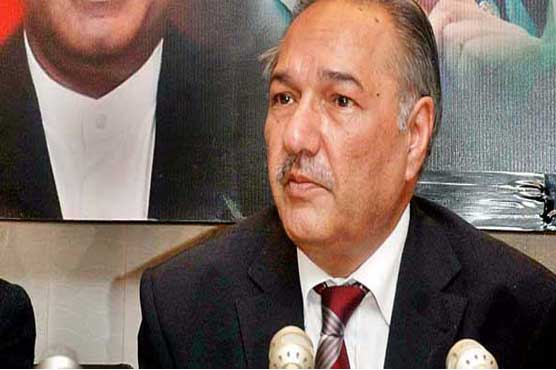
Summary Defence Minister has rejected Mike Mullens claims in fresh rebuttal of US allegations.
Ahmed Mukhtar said the US should have conducted even the Abbottabad operation in cooperation with Pakistan.He also urged the US to share intelligence with Pakistan regarding Haqqani network and both the countries should together act against ant threat.He also maintained that Pakistan and US are allies and any statement cannot damage the ties between the two countries. Earlier, President Zardari and Prime Minister Gilani have rejected Admiral Mike Mullen’s allegations.Prime Minister Yousaf Raza Gilani called on President Asif Ali Zardari at the Blawal house. Both the leaders dismissed US chairman of the Joint Chiefs of Staff Admiral Mike Mullen’s accusations that Inter-Services Intelligence (ISI) was behind attacks on US Embassy in Afghanistan.President and the Prime Minister said Pakistan wants to live with peace and dignity in the region.Both the leaders also discussed law and order and political situation in the country. The Prime Minister also briefed the President on his brief visit to Afghanistan on Thursday to condole the death of former Afghan President and Chairman of the High Peace Council Prof Burhanuddin Rabbani who was assassinated in Kabul in a suicide attack on Tuesday. The President also hosted dinner for the Prime Minister.Pakistani Foreign Minister Hina Rabbani Khar dismissed the claims as mere allegations. She warned the U.S. that it risked losing Pakistan as an ally and could not afford to alienate the Pakistani government or its people.If they are choosing to do so, it will be at their own cost, Khar told on from New York City, where she is attending a U.N. General Assembly meeting. Anything which is said about an ally, about a partner publicly to recriminate it, to humiliate it is not acceptable.Khars comments were first aired in Pakistan on Friday.The foreign minister spoke following congressional testimony by the top U.S. military officer about Pakistan.Adm. Mike Mullen, chairman of the Joint Chiefs of Staff, accused Pakistans Inter-Services Intelligence agency Thursday of supporting the Haqqani insurgent network in planning and executing the assault on the U.S. Embassy in Afghanistan last week and a truck bomb that wounded 77 American soldiers days earlier.He also said the U.S. had credible information that Haqqani extremists, with help from the ISI, were responsible for the June 28 attack on the Inter-Continental Hotel in Kabul and other small but effective assaults.The Haqqani insurgent network is widely believed to be based in Pakistans North Waziristan tribal area along the Afghan border. The group has historical ties to Pakistani intelligence, dating back to the war against the Soviets in Afghanistan in the 1980s. The U.S. military has said the Haqqani network, which has ties to both al-Qaida and the Taliban, poses the greatest threat to American troops in Afghanistan.Mullen insisted that the Haqqani insurgent network acts as a veritable arm of the ISI, undermining the uneasy U.S.-Pakistan relationship forged in the terror fight and endangering American troops in the almost 10-year-old war in Afghanistan.Pakistan is exporting violence and threatening any success in Afghanistan, Mullen told the Senate Armed Services Committee.In choosing to use violent extremism as an instrument of policy, the government of Pakistan, and most especially the Pakistani army and ISI, jeopardizes not only the prospect of our strategic partnership but Pakistans opportunity to be a respected nation with legitimate regional influence, Mullen said. They may believe that by using these proxies, they are hedging their bets or redressing what they feel is an imbalance in regional power. But in reality, they have already lost that bet.Mullens harsh words marked the first time an American official had tied Pakistans intelligence agency directly to the attacks and signaled a significant shift in the U.S. approach to Islamabad. In the past, U.S. criticism of Pakistan largely had been relayed in private conversations with the countries leaders while American officials publicly offered encouraging words for Islamabads participation in the terror fight.Mullen did not provide specific evidence backing up his accusations or indicate what the U.S. would do if Pakistan refuses to cut ties to the Haqqani network. The U.S. has repeatedly demanded that Pakistan attack the insurgents and prevent them from using the countrys territory.Pakistan has denied ties to the group in the past and has said it cannot attack them because its troops are stretched too thin fighting other militants in the countrys semiautonomous tribal region. Many analysts believe, however, that Pakistan wants to remain on good terms with the militants because they could be useful allies in Afghanistan after foreign forces withdraw.Mullens comments carry particular weight since the Joint Chiefs chairman has nurtured ties with the Pakistanis during his tenure, meeting with officials more than two dozen times. His congressional testimony was his last before he retires next week.Mullen reaffirmed his support for continued U.S. engagement with the nuclear-armed Pakistan and warned of the consequences if the relationship should break down. But his comments could make that engagement harder and continue a recent downward trend in ties between the two countries.The relationship took one of its hardest hits when U.S. commandos sneaked into Pakistan on May 2 and killed al-Qaida chief Osama bin Laden in a garrison town not far from Islamabad.The covert raid outraged the Pakistani government because it was not told about it beforehand, while bin Ladens presence in Abbottabad raised further suspicions among U.S. officials about the countrys duplicity in the anti-terror fight.