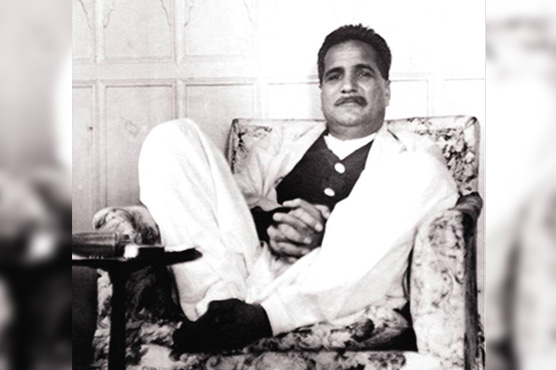
Summary Iqbal built a conceptual scheme in which religion, science and philosophy all have a place
By Fuzail Zafar
Born to a modest Muslim family in Sialkot, Muhammad Iqbal always had within him the ingredients of an above par human being. As a student, he continued to surpass his fellows by securing top grades and boggle the minds of his teachers with curt quips. He had started writing poetry as soon as he entered class nine, and begun versifying under the pen-name of Iqbal in his first year at Scotch Mission College. On top of it, he was an extra-ordinary linguist as he first excelled in Arabic at a very young age, knew the ins-and-outs of Persian almost instinctively, mastered the English lexicon during intermediate and bachelors, and became proficient in German within three months after getting admission at the Munich University.
This young, gifted and ambitious young man, like other aspiring Muslim leaders of the British India, was confronted with manifold intellectual and identity crisis. Thanks to Sir Syed’s teachings, the dilemma every Mohammaden student would face was to reconcile with the British modus operandi with continuously striving, at the same time, to find a permanent liberation formula for the wretched Muslims of the sub-continent. Very few, if any, thinkers from within the Muslim community managed to manoeuvre as successfully in this bay of contradiction as did Iqbal.
On a personal level, Iqbal was what any Muslim man of his day could be: blessed by freedom yet tormented by it. He was married thrice, not once with the woman he loved. When he tied the arranged knot with Karim Bibi in 1895, he had not yet experienced mental compatibility, intellectual affinity and feeling of love, which were all showered upon him during his stay in Europe, by virtue of a literate and a literary woman, Attia Faizi. This pithy connection mushroomed in the gardens of Cambridge and Heidelberg. This short-lived period of interaction had transformed the erstwhile energetic and a lively Muhammad Iqbal into an increasingly introvert and lost Allama Iqbal, as he could never propose Attia.
Exposure to the West:
Had he never visited Europe and observed its civilisation so keenly, he would not have become the philosopher that he was. European thought bore profound influence on Iqbal’s worldview as he was immensely attracted by the philosophical works of Nietzsche, Goethe, Hegel, and Bergson. His own philosophy, however, rested largely on refuting the concepts of these intellectual giants. For instance, Iqbal criticised his biggest inspiration Nietzsche for eliminating the dimension of morality in pursuit of rationalism. This method of Iqbal, that is, observing a particular system closely and then developing its antitheses somewhat resembled to the method of Karl Marx, who studied capitalism for 20 years before developing a comprehensive theory to oppose it.
Iqbal also vehemently chided Western symbolic narratives.
“In appearance trade, in reality gambling
Profit for one, for thousands sudden death
Science, philosophy, colleges, constitutions
Preach man’s equality and suck man’s blood
Want and idleness, lewdness and intoxication
Are these the mere triumphs of the Occident?”
Tantalisingly, for Iqbal, there was nothing wrong with the fact that the world of Islam is spiritually moving towards the West, for European culture, on its intellectual side, is only a further development of the Islamic socio-political thought. However, Iqbal feared that the dazzling exterior of European culture, that is, the so called symbolic narratives, might arrest our movement and we may fail to reach the true inwardness of that culture.
Stint in Politics:
It was Allama’s entry into politics which enabled him to contemplate and present his scheme for a separate homeland for Muslims in the Indian sub-continent. After his return from Europe in 1908, he gained considerable recognition by the Punjabi political elite. He remained an active Muslim League member despite consuming larger share of time in poetry and practising law. Until the First World War, he favoured the notion of a united India.
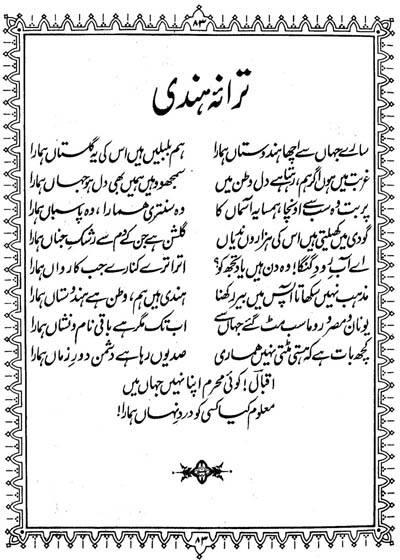
However, after dissipation of Ottoman Caliphate after world war and intensified sentiments of Hindu nationalism thereafter, Iqbal’s views crystallised around solidarity within the Muslim Ummah. And he began to distance himself from the “nationalist” Congress. He, however, never veered away from his overarching idea: humanitarianism. That being said, he believed that Islam, if properly understood and practiced, could satisfy all human needs and aspirations. Though a devout Muslim, there is in Iqbal’s words a message even for those who do not share his religious beliefs. As E. M. Forster points out about Iqbal, “whatever his opinions, he was no fanatic, and he refers to Hindus and Christians with courtesy and respect.”
Iqbal’s Philosophy:
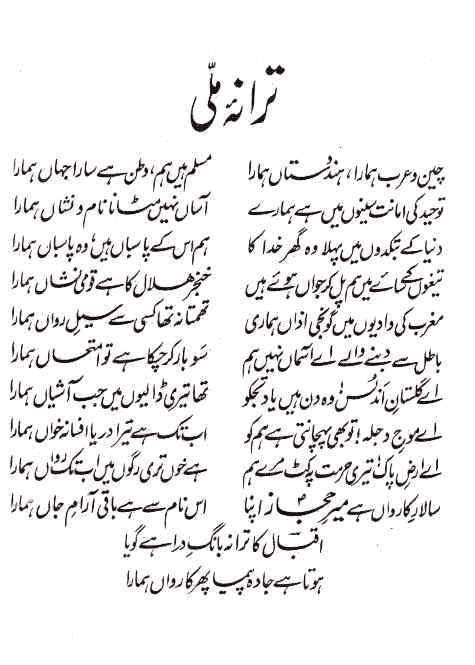
In Reconstruction of Religious Thought in Islam, we find Iqbal’s finest philosophical treatise. He undertook, with unswerving determination, the weary task to build a conceptual scheme in which religion, science and philosophy all have a place. Iqbal argues in his first reconstruction lecture: “The point to ponder is the general empirical attitude of the Quran which engendered in its followers a feeling of reverence for the actual and ultimately made them the founders of modern science.”
The central concept of Iqbal’s philosophy is Khudi, which has been enshrined in both his Urdu and Persian poetry as well as in his English prose. In English, Khudi can be translated as Self or Ego. Unlike its general meaning, Khudi in Iqbal’s view does not mean pride. It means self awareness and loftiness of character. As Iqbal puts it, "hard his lot and frail his being, like a rose leaf, yet no form of reality is so powerful, so inspiring, and so beautiful as the spirit of man".
Another aspect of Iqbal’s philosophy is that Iqbal’s concept of Islam is bound up with majesty – or power. If majesty is the objective of Islam, its manifestation is the state; and the state, in turn, is the territorial specification of Islam. This line of thinking culminated in Iqbal’s demand for present-day Pakistan in his historic 1930 AML presidential address in Allahbad.