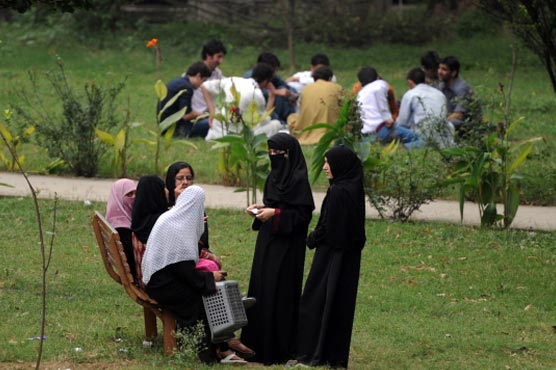
Summary Experts have called for a policy to keep a check on extremism in universities. (Photo: AFP)
(Web Desk) – The general perception about terrorism is that the radicalization of children and young men and women occurs in madrassahs (seminaries). However, leading academics are of the view that this is changing; seminaries are no more the only hotbeds of radicalization. Recently, experts have expressed concerns that are quite shocking and have warned that extremism can now be found in public and private institutions.
In a recent seminar held by Sindh’s Counter-Terrorism Department titled ‘Growing Radicalisation in Educational Institutions’, experts and academics have called for a policy to keep a check on extremism that is no longer limited to seminaries but is also starting to take hold in universities.
Militants to emerge from universities:
The main purpose of the said seminar was to deliberate over how to build a counter-narrative against extremism after discussions with various segments of society. Vice chancellors and various other officials of around 40 universities attended the event. The seminar aimed to initiate a discussion between law enforcement and administration of educational institutes to seek out the solutions to youth radicalization.
According to a report in BBCurdu, the head of the Counter-Terrorism Department Sindh, Additional IG Dr Sanaullah Abbasi, expressed the view that radicalization was growing in academic institutes with the ‘next generation of militants more likely to have university education than a madrassah background’. The cases of Naureen Leghari, who was arrested from a militant hideout in Lahore a few months back, and Saad Aziz, who was involved in Safoora Goth carnage, were cited to lend support to this theory.
Parents and university administration unaware:
Experts were of the view that parents are university administration are not aware or are not willing to take action when they witness suspicious activities on a student’s part.
According to a report in Dawn.com, SSP Munir Sheikh, while speaking on the event, said that Naureen Leghari used to remain absent from the university during her class breaks but the university did not inform the administration. Moreover, in Liaquat Medical University, girls were forming groups of ten and preaching in the university while the university turned a blind eye to their activities.
Furthermore, Counter-Terrorism Department’s SSP (Intelligence) Omar Shahid Hamid was of the view that unlike those radicalized in madrassahs, this ‘online generation’ was sophisticated and had reasons and ideology to back their actions.
CTD SSP Raja Omer also talked about how parents and the university administration were not aware of the transformation their children or students were going through. He cited the case of Saad Aziz and 19 other cases of radicalized youths, who became isolated and stopped using mobile phones but their parents did not notice. He added that even rich and educated youth from areas like Defence were joining the Islamic State group.
A new policy: Development of a counter-narrative
Vice chancellors and officials of different universities expressed their views on the problem and how to deal with this menace. VC of Shaheed Benazir Bhutto University Lyari, Akhtar Baloch highlighted the importance of a counter-narrative to challenge militancy. Baloch also lamented the fact the elimination of liberal and progressive forces for the past three decades through a particular narrative.
Pro Vice Chancellor of NED University Dr Muhammad Tufail said that it was not possible for university administration to identify behavioural changes in students as they were not trained for this. Although, he added, the university administration was ready to cooperate with the law enforcement with regards to this matter.
Moreover, an official of LUMHS, informed the audience that they were engaged in monitoring students after the case of Naureen Leghari, and gave the example of how the university had noticed behavioural changes among female students and sent notices to their parents about their possible radicalization. A vigilance team has also been set up in Shaheed Benazir University Nawabshah after the Peshawar APS tragedy to inform parents if any student was found to have strange behaviour.
However, some officials also conveyed that fighting extremism was not in their domain, citing lack of training and funding. There were also complaints of agency personnel present on campus interfering with administration instead of playing a role in preventing militancy. Officials were of the view that the government and law enforcement can play a role in the prevention of militancy in higher education institutes.