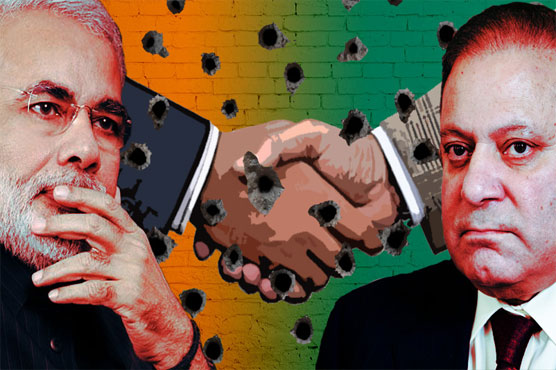
Summary Pakistan's relations with India in 2016 were tantamount to a boat dwindling in a stormy sea.
LAHORE (Web Desk) - All is well that ends well! 2015 ended on a high note regarding the Indo-Pak ties when Indian Prime Minister Narendra Modi made a‘surprise visit’ to Pakistan to meet Prime Minister Nawaz Sharif.
But what happened in the next year was a tumultuous turn for the already fragile Indo-Pak ties.
Pakistan’s relations with India in 2016 were tantamount to a boat dwindling in a stormy sea and became more tense and edgy with time.
As the year begun, Pathankot Air Force base was attacked by militants on January 2 as a result of which six Indian soldiers and five attackers were killed.
India as following its old tradition put the entire blame on Pakistan and so in this way the Indo-Pak relations received the first blow.
The attack was followed by the arrest of India’s RAW agent Kulbhushan Yadav from Balochistan’s Saravan area while he was crossing the Pak-Iran border in the first week of March.
Yadav not only confessed to involvement in subversive acts in Karachi and Balochistan but also admitted that the anti-Pakistan activities were actually funded by India.
After the confessional statement, India accepted Yadav as its citizen but said that he was a retired Navy officer.
The relations had not fully recovered from the blow when Hizbul Mujahideen commander Burhan Wani was martyred by Indian security forces in occupied Kashmir in July, which drove Pakistan and India in opposite directions.
Pakistan raised India’s human rights violations and atrocities in occupied Kashmir on international forums including the UN General Assembly session where PM Nawaz said that they “fully support the demand of the Kashmiri people for self-determination”.
With Kashmir’s freedom movement in full swing, September arrived with another attack on an Indian army base in Uri area of occupied Kashmir that added fuel to the fire.
India as usual accused Pakistan for the attack that killed 19 of its soldiers.
Frustrated by its own failure to counter the militant attacks, India took the blame game way to ahead and falsely claimed of carrying out surgical strikes on Pakistan’s soil.
Pakistan strongly rejected the strikes and termed the assertions as ‘baseless’. In a show of might and a misapprehension of being a superpower of the region, India forgot that during surgical strikes the target is attacked not on the land but by air.
Moreover, India also failed to provide any proofs of the attack hence; becoming a mock of its own bragging.
Desperate in anger the Indian fanatics targeted the film industry and banned all the Pakistani actors from carrying on with their business commitments in India until normalcy returns.
Indian Prime Minister refused to attend the SAARC conference due to held in Islamabad in November which was followed by other countries too. Consequently, the conference had to be postponed.
But this wasn’t the end.
From then, started the unprovoked firing by the Indian army at the Working Boundary and Line of Control (LoC) in October and November.
Read: India violated LoC ceasefire more than 90 times this year: FO spokesman
While violating the ceasefire, the firing became a norm from the Indian side and was so intense at times that it posed threat of an eruption of a formal war.
The unprovoked firing caused immense loss of human life and property in Pakistan.
Alongside the border confrontation, a major diplomatic row also erupted between the two countries at the end of October when India allegedly declared a Pakistan High Commission staffer as persona non-grata for espionage activities with a swift tit-for-tat action by Pakistan.
On November 14, an Indian submarine tried to enter into the Pakistani waters but the bid was efficiently foiled by the Pakistan Navy.
Surpassing all limits, Indian army targeted a passenger bus in Azad Kashmir’s Neelum Valley on November 23 which killed atleast nine civilians.
India’s animosity took the turn towards ending the Indus water treaty with PM Modi saying in one of his speeches that they won’t let India’s water flow into Pakistan.
Take a look: Narendra Modi threatens to cut off Pakistan s water supply
However; Pakistan made an effort to maintain peace and resolve issues through dialogue. Foreign Advisor Sartaj Aziz attended the Heart of Asia conference in Amritsar.
But India did not refrain from its dirty tactics here. It restricted Sartaj Aziz’s movement to the hotel and abstain him from talking to Pakistani media.
High Commissioner Abdul Basit was also hindered from talking to Pakistani media but he gave a befitting reply to it.
By accusing Pakistan of terrorism, Indian only wants to internationally isolate Pakistan and divert the world’s attention from Kashmir’s freedom movement and its human rights violations in the valley.
Meanwhile, the change of military heads from both sides of the border has raised eyebrows as it could be a turning point in the relations of the nuclear-armed neighbours. Only time will tell the nature of the change!