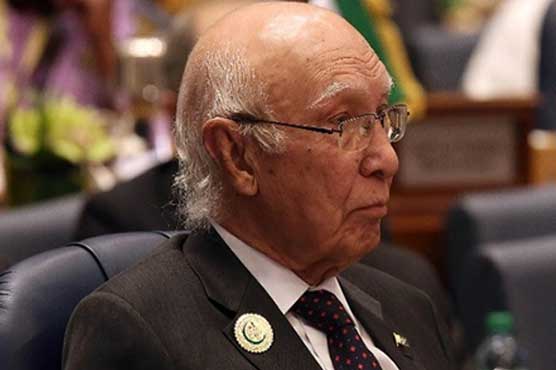
Summary Advisor on Foreign Affairs Sartaj Aziz addressed the National Assembly today.
ISLAMABAD (Web Desk/Dunya News) – Addressing the National Assembly today (Tuesday), Prime Minister’s Advisor on Foreign Affairs Sartaj Aziz said that war against terrorism is incomplete without border management mechanism, Dunya News reported.
Aziz rejected the impression that Pakistan is being isolated and said that we have to prioritize our foreign policy according to new alignments taking place in world.
He said China-Pakistan Economic Corridor (CPEC), CASA-1000, TAPI and Iran-Pakistan Gas Pipeline Project are concrete achievements which will help increase connectivity. He pointed out that with the SCO membership, Pakistan s political role will be enhanced.
He stated that Indian Prime Minister (PM) Narendra Modi’s visit to Islamic countries was declared a failure of Pakistan’s foreign policy. He said that the country is working upon its policy of non-interference in the affairs of other states. “The impression was given that our (Pakistan’s) relations with Muslim counties have deteriorated after Modi paid visit to two such countries,” he said.
We have historic and religious relations with Muslim countries, he added.
Sartaj said that it was not the first time that an Advisor to the Prime Minister was given the task of handling the affairs of the Foreign Ministry, adding that such examples were there to be witnessed in the past as well.
Advisor to the PM said that a former Pakistani Ambassador to the United States was involved in creating difficulties for his own country, adding that the ambassador lobbied against Pakistan.
Sartaj Aziz pointed out that relations with Iran are moving in the right direction and after lifting of sanctions against Iran, relations between Pakistan and Iran will be strengthened.
He said Pakistan is pursuing a policy of no favourite regarding Afghanistan and making efforts through Quadrilateral Group to establish peace in that country.
Sartaj Aziz’s remarks came a day after an Afghan delegation led by Deputy Foreign Minister Hekmat Khalil Karzai visited Islamabad for discussions on issues relating to the Torkham border and other matters pertaining to border management. The Pakistan delegation was led by Foreign Secretary Aizaz Ahmed Chaudhry.
The Afghan delegation had arrived in Islamabad following a telephone conversation of Aziz with Afghan National Security Adviser Hanif Atmar on 15 June 2016 to address the situation arising from recent events at the Torkham border crossing and to find a way forward on efforts for border management.
Talks between the two delegations were held in a cordial atmosphere marked by a mutual desire to amicably resolve border related issues. Both sides decided to work in the spirit of good neighbourly relations and friendly cooperation between the two countries.
The two sides agreed that the ideas generated in today s deliberations will be shared with the leadership and further discussed and refined during a meeting between the Adviser and the Afghan Foreign Minister on the sidelines of the forthcoming SCO Summit in Tashkent on 23-24 June 2016.
During the discussions, it was emphasized that there was a need for creating a suitable mechanism for consultation on border management issues. Effective border management is vital for promoting peace, countering terrorism and strengthening relations between the two countries.
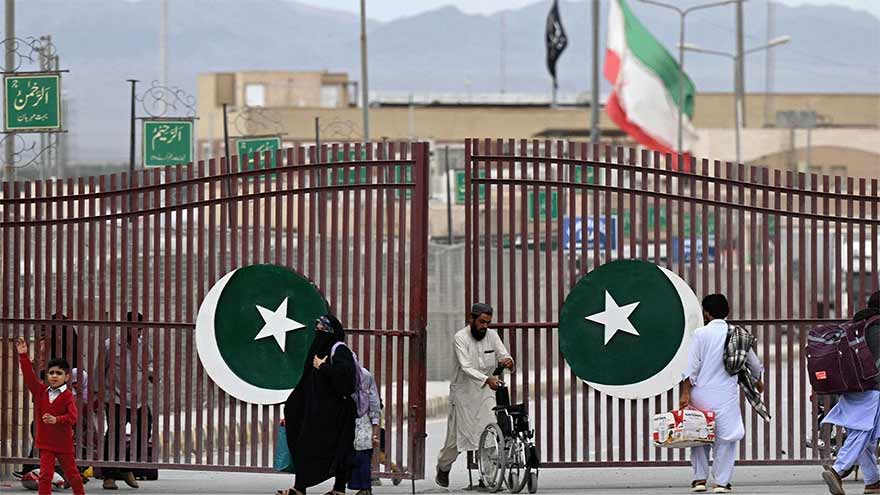
The two neighbors last week traded several bouts of deadly gunfire and artillery at the Torkham border after Pakistan started building a fence on its side, each side accusing the other of starting the violence.
Pakistan shares a nearly 2,600 kilometer (1,625 mile) -long border with Afghanistan and militants operate on both sides of the border. Pak Army had earlier said that there had been incursions by militants from across the Torkham border lately, which prompted authorities to implement more effective border control.