Summary The decision comes ahead of President Obama's meeting on Thursday with Prime Minister Nawaz Sharif
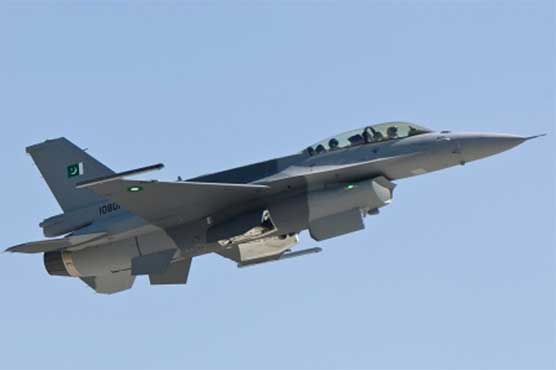
WASHINGTON (Web Desk) – The Obama administration is all set to sell as many as eight new F-16 fighter jets to Pakistan, in a bid to strengthen a tenuous partnership despite Washington s reservations about Pakistan s growing nuclear arsenal, New York Times reported.
As per report filed by Matthew Rosenberg and David Sanger, the decision comes ahead of President Obama’s Thursday meeting with Prime Minister Nawaz Sharif, which is to be dominated by the president’s decision to extend the American troop presence in Afghanistan and a quiet effort to get Mr. Sharif to halt the deployment of a new generation of tactical nuclear weapons.
Earlier in April, the US State Department approved Pakistan’s request, seeking million dollars for military hardware and equipment, identifying Pakistan as a country of vital importance for US foreign policy and national interests.
A US based think tank has estimated that Pakistan will become the fifth largest nuclear power by 2025 on the basis of nuclear warheads development performance over past 20 years and its current weapons deployments.
In a new report released by the Bulletin of the Atomic Scientists, two authoritative nuclear analysts, Hans M. Kristensen and Robert S. Norris, estimated that Pakistan s nuclear weapons stockpile has increased to between 110 and 130 warheads from an estimated 90 to 110 in 2011.
The analysts foresee it possibly expanding further to 220 to 250 warheads in another 10 years. That would make Pakistan the world s fifth largest nuclear weapons state behind the United States, Russia, China and France.
It is the nature, not the size, of Pakistan’s nuclear arsenal that tops Obama’s agenda. Over the past two weeks, officials in Washington have said they are exploring whether a deal might be possible to halt the deployment of tactical nuclear weapons that American experts fear are vulnerable to being launched without authorization, or stolen, on the battlefield.
Until earlier this week Pakistani officials had said nothing about the program, although the foreign secretary, Aizaz Chadhary, told reporters in Islamabad on Tuesday that the country had built “low-yield nuclear weapons” to counter India.
It is unlikely that either side will talk publicly about nuclear weapons on Thursday, but Obama plans to raise the issue at length, according to administration officials.
Selling Pakistan more arms, however, is an issue that is often discussed more publicly to signal that Pakistan is acting in its role as a “major non-NATO ally,” a designation Bush bestowed after the attacks of Sept. 11, 2001.
The aircraft sales, which the United States (US) Congress could block, would be a symbolic step given Pakistan s current large fleet of fighter jets.
The new fighter jets would add to Pakistan’s sizable force of fighter jets which includes more than 70 F-16s and dozens of French and Chinese attack aircraft, the report said.
Much of the tension has arisen from Pakistan’s ties to elements of the Taliban, especially the Haqqani Network, which is linked to al Qaeda and is seen by American commanders as the most deadly faction of the Taliban fighting in Afghanistan. In recent years, numerous American officials have publicly and privately complained about the support to the Haqqanis provided by Pakistan’s main spy agency, the Directorate of Inter-Services Intelligence.
At the same time, many American officials have continued to insist that the best path forward with Pakistan is to work with its elected leaders and military commanders in hopes of convincing them to crack down on all militants, not just those who actively fight the government there. The Obama administration is also pressing PM Nawaz to assist in bringing the Taliban to peace talks, an effort that the administration has pursued for years. As a result, officials are loath to antagonize Islamabad at a crucial moment in the war in Afghanistan.
The Afghan peace process appeared to be gaining momentum this summer with meetings between Afghan officials and Taliban representatives in Pakistan.
But it was derailed by news that the Taliban’s elusive leader, Mullah Muhammad Omar, died about two years ago, and the insurgents have made significant gains in the months since. Late last month they seized a city for the first time since 2001, taking Kunduz, Afghanistan, and holding off Afghan forces for more than two weeks before pulling back.
Fearful that Afghan forces would be outmatched without American support, Obama announced last week that American troops would remain in Afghanistan through the end of his term. But after 2016, there would only be about 5,500 Americans left in Afghanistan, so the administration is eager to revive the peace process, which is expected to be on the agenda when Obama and PM Nawaz meet on Thursday.
While Pakistan has gone after Qaeda operatives since 2001, and allowed the CIA. drone program to strike targets in the country’s tribal areas, it has also provided a safe haven for the Taliban and supported elements of the Afghan insurgency. Pakistan has also supported other militant groups fighting in Kashmir and targeting India.
Many in Congress fear that the F-16 jets are more useful to Pakistan in its long confrontation with India than for counterterrorism. It is unclear if Congress will approve the deal: Congress and the State Department are already in a standoff over an effort to sell used Navy cutter vessels to Pakistan earlier this year.