Summary A psychological war is being fought in the name of negotiations, he claimed.
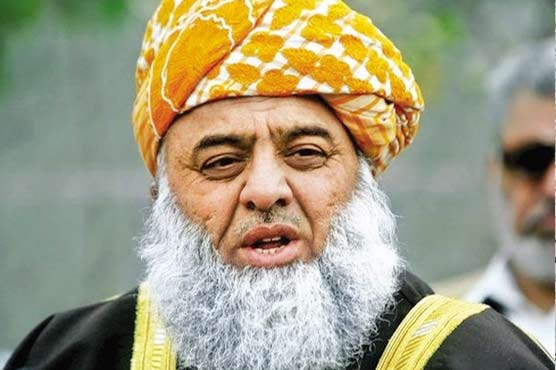
MULTAN (Dunya News) – Jamiat Ulama-e-Islam Fazl (JUI-F) Maulana Fazlur Rehman said on Friday that negotiations with militants will be successful if done by addressing militants instead of Taliban and that if task is assigned to the local tribal jirga, Dunya News reported.
Addressing a press conference at Madrassa Qadria Hanfia in Multan, he said that he has advised the Prime Minister Nawaz Sharif to bring army on board for success of dialogue, adding that governments keep changing.
He claimed that a psychological war is being fought in the name of negotiations, adding that he is against this mechanism of dialogue.
JUI-F Chief said that currently the negotiations are being held between non-stake holders and non state actors. He said that negotiation committee is dissolved while admitting defeat and that the dialogue is stuck because of petty matters at this time.
He said that his party is the biggest proponent of dialogue and that his party is willing to play a role if government changes its mechanism.
Fazlur Rehman claimed solution to Kashmir conflict is easy, alleging that the states of India and Pakistan do not want to resolve it. India wants to weaken our agriculture and economy by stopping our water, he claimed.
He said that madrassas play an important role in keeping the civilization alive, claiming that intervention in religious schools is being attempted as part of international conspiracies.
Insurgency, dialogue or operation:
Pakistan is facing almost a decade old insurgency at the hands of Taliban factions grouped under umbrella of Tehrik-e-Taliban. The new governing parties including Pakistan Muslim League Nawaz (PMLN) and Pakistan Tehrik-e-Insaf (PTI) had campaigned in elections in favour of resolving the years old conflict through dialogue.
The ruling party secured a vote of confidence in favour of dialogue through a session of All Parties Conference (APC) and to act on the recommendation upon willingness from Taliban, committees to represent both government and Taliban were formed and the process continued.
However, all negotiations stalled as a number of civilians and military personnel were brutalized whose responsibility was claimed by Taliban.
Following a number of air strikes by Pakistan military, Taliban agreed to a month-long ceasefire which was later reciprocated by the government.
Government also dissolved the existing committees emphasizing the need of moving forward the negotiations to next phase by restructuring the existing government committee to hold ‘direct talks’.