Summary More than 60,000 people live within 50 kilometres of the epicentre, according to the UN.
KHUZDAR (Dunya News) - Poor infrastructure and scattered population are hampering relief activities in the quake-hit areas of Balochistan.
Rescuers struggled Wednesday to help thousands of people injured and left homeless after their houses collapsed in a massive earthquake in southwestern Pakistan as the death toll rose to 261.
According to an official, delivery of food items and medicine has been slowed by impassable highways and severed telecommunications. The affected areas consist of villages with mostly mud-brick homes and poor to non-existent transportation infrastructure, leaving rescue teams worried the death toll will rise sharply.
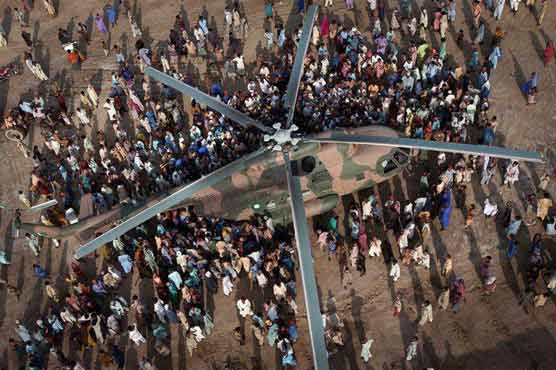
The Pakistani military said it had rushed almost 1,000 troops to the area overnight and was sending helicopters as well. A convoy of 60 Pakistani army trucks left Karachi early Wednesday, carrying supplies for those affected by the quake.
Local officials said they were sending doctors, food and 1,000 tents for people who had nowhere to sleep as strong aftershocks continued to shake the region.
"We need more tents, more medicine and more food," said A spokesman for the provincial government, Jan Mohammad Bulaidi. He described a horrific scene of people who lost limbs in the quake and who will need to be sent to hospitals in major cities of Quetta, the capital of Baluchistan province, and Karachi along the Arabian Sea.
The quake flattened wide swathes of Awaran, the district where it was centered. Most of the victims were killed when their houses collapsed.
Local Pakistani TV channels showed images of devastated villages in remote areas. Houses made mostly of mud and handmade bricks had collapsed, walls and roofs caved in and people s possessions scattered on the ground.
An unidentified man who appeared to be injured in his leg was shown supported by two men helping him walk. He said he was drinking tea when he heard a loud bang: "It shook everything."
In Pakistani cities such as Karachi and Quetta people ran into the streets in fear, praying for their lives when the quake hit.
The United Nations said in a statement that it mourned the victims and was in close contact with the Pakistani government to provide help if needed.
Pakistani officials were investigating a small island that appeared off the coast of Pakistan after the quake, apparently the result of earth and mud pushed to the surface by the quake.
Gwadar Police Chief Pervez Umrani said people gathered on the beach to see the land mass The head of the Geological Survey of Pakistan confirmed that the mass was created by the quake and said scientists were trying to determine how it happened. Zahid Rafi said such masses are sometimes created by the movement of gases locked in the earth under the sea, pushing mud and earth up to the surface in something akin to a mud volcano.
"When such a strong earthquake builds pressure, there is the likelihood of such islands emerging," he said. "That big shock beneath the earth causes a lot of disturbance."
To get a better idea of what the island is made of and how permanent it is, scientists will have get samples of the material to see if it s mostly soft mud or rocks and harder material. He said these types of islands can remain for a long time or eventually subside back into the ocean, depending on their makeup.
A Pakistani Navy team reached the island by midday Wednesday, navy geologist Mohammed Danish told a local news channel. He said the mass was about 60 feet (18 meters) high, 100 feet (30 meters) long and 250 feet (76 meters) wide.
"There are stones and mud," he said, warning residents not to try to visit the island. "Gasses are still emitting."
Such land masses have appeared before off Pakistan s coast, said Muhammed Arshad, a hydrographer with the navy. After quakes in 1999 and 2010, new land masses rose up along a different part of the coast about 282 kilometers (175 miles) east of Gwadar, he said.
He said each of those disappeared back into the sea within a year during the monsoon season, a period of heavy rain and wind that sweeps Pakistan every summer. He said that in the area where the island was created on Tuesday, the sea is only about six to seven meters (23 feet) deep.
Baluchistan is Pakistan s largest province but also the least populated and most impoverished. Medical facilities are few and far between and often poorly stocked with medicine or qualified personnel. Awaran district has about 300,000 residents spread out over 29,000 square kilometers (11,197 sq. miles).
Many residents are believed to be involved in smuggling fuel from Iran, while others harvest dates.
The area where the quake struck is at the center of an insurgency that Baluch separatists have been waging against the Pakistani government for years. The separatists regularly attack Pakistani troops and symbols of the state, such as infrastructure projects.
Baluchistan and neighboring Iran are prone to earthquakes. A magnitude 7.8 quake centered just across the border in Iran killed at least 35 people in Pakistan last April.