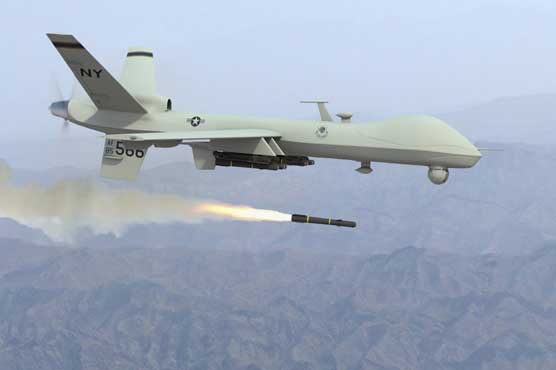
Summary Former drone operator talked about how he is haunted by more than 1,600 deaths he contributed to.
NEW YORK (Agencies) - A former Air Force drone operator spoke to NBC News about how he is haunted by the more than 1,600 deaths he contributed to.
In the interview, Brandon Bryant, 27, spoke about the deaths he witnessed from afar in vivid detail. In one instance, he recalled operating the camera on a drone over Afghanistan while sitting at an Air Force base in Nevada. The missiles hit the three targeted men. Bryant says the men may have been carrying rifles but he isn t convinced they were necessarily "bad guys."
"The guy that was running forward, he’s missing his right leg,” he recalled. “And I watch this guy bleed out and, I mean, the blood is hot.” As the man died his body grew cold, said Bryant, and his thermal image changed until he became the same color as the ground.
Bryant told NBC News that he served as a drone sensor operator for five years. His work entailed guiding drones over Iraq and Afghanistan. His duties did not include the firing of missiles, but the missions he took part in caused more than 1,600 deaths.
Bryant explained to NBC News that he now suffers from post traumatic stress disorder (PTSD). He said he "lost respect for life" and started to feel like a sociopath. Those feelings were compounded near the end of his time in the Air Force.
In an interview with NBC News, he provided a rare first-person glimpse into what it’s like to control the controversial machines that have become central to the U.S. effort to kill terrorists.
He says that as an operator he was troubled by the physical disconnect between his daily routine and the violence and power of the faraway drones.
“You don t feel the aircraft turn,” he said. “You don t feel the hum of the engine. You hear the hum of the computers, but that s definitely not the same thing.”
At the same time, the images coming back from the drones were very real and very graphic.
“People say that drone strikes are like mortar attacks,” Bryant said. “Well, artillery doesn t see this. Artillery doesn t see the results of their actions. It s really more intimate for us, because we see everything.”
A self-described “naïve” kid from a small Montana town, Bryant joined the Air Force in 2005 at age 19. After he scored well on tests, he said a recruiter told him that as a drone operator he would be like the smart guys in the control room in a James Bond movie, the ones who feed the agent the information he needs to complete his mission.
He trained for three and a half months before participating in his first drone mission. Bryant operated the drone’s cameras from his perch at Nellis Air Force base in Nevada as the drone rose into the air just north of Baghdad.
Bryant and the rest of his team were supposed to use their drone to provide support and protection to patrolling U.S. troops. But he recalls watching helplessly as insurgents buried an IED in a road and a U.S. Humvee drove over it.
“We had no way to warn the troops,” he said. He later learned that three soldiers died.
And once he had taken part in a kill, any remaining illusions about James Bond disappeared. “Like, this isn’t a videogame,” he said. “This isn’t some sort of fantasy. This is war. People die.”
Bryant said that most of the time he was an operator, he and his team and his commanding officers made a concerted effort to avoid civilian casualties.
But he began to wonder who the enemy targets on the ground were, and whether they really posed a threat. He’s still not certain whether the three men in Afghanistan were really Taliban insurgents or just men with guns in a country where many people carry guns. The men were five miles from American forces arguing with each other when the first missile hit them.
“They (didn’t) seem to be in a hurry,” he recalled. “They (were) just doing their thing. ... They were probably carrying rifles, but I wasn t convinced that they were bad guys.“ But as a 21-year-old airman, said Bryant, he didn’t think he had the standing to ask questions.
He also remembers being convinced that he had seen a child scurry onto his screen during one mission just before a missile struck, despite assurances from others that the figure he’d seen was really a dog.