Updated on
Summary France's Muslim community is the largest in Western Europe.
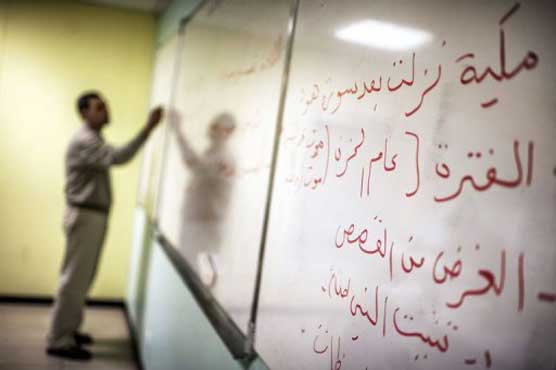
Deep in the wooded hills of Burgundy in central France, an Islamic institute is training aspiring French imams who hope to minister to the countrys large Muslim population.Early in the morning, some 200 students from across the country stream into the European Institute of Human Sciences de Saint-Leger-de-Fougeret, where they learn to recite the Holy Quran and study Islamic theology and Arabic literature.After seven intensive years of study, only 10 or so graduates each year to lead prayers or preach at mosques.Estimates of Frances Muslim population vary widely, from between 3.5 million and 6.0 million, though there is little hard evidence as to how many are practising. In any event, Frances Muslim community is the largest in Western Europe.Relations between the authorities and Muslims, many of them second- or third-generation immigrants, chiefly from North Africa, have often been tense. Recently,France has implemented a contentious ban on women wearing full veils.Over the past nine years, various governments have encouraged the professional training of local religious leaders. Interior Minister Manuel Valls recently backed the practice, even if the job of imam is badly paid, if at all, and enjoys no official recognition.-- Equipped with knowledge --The initiative goes back 20 years when the Union of Islamic Organisations in France, which has close ties to the Muslim Brotherhood, converted a former childrens holiday centre into the institute. Its stated aim is to train imams equipped with a solid knowledge of Islam and the socio-cultural realities of Europe.The idea was to provide an alternative to the recruitment of foreign imams, who often spoke no French and had little or no knowledge of French lifestyles.The training of imams who are products of French society is vital: Today 70 percent of the faithful dont speak Arabic, said the institutes director Zuhair Mahmood.Initially financed by the Gulf States, the school depends heavily on fees of about 3,400 euros ($4,400) a year -- board and lodging included.Since I was small I have dreamed of becoming an imam, said 18-year-old Wahib, who did not want to give his last name, but seven years is long and there are no grants.Apart from the rural setting, the atmosphere in the run-down prefabricated corridors of the institute is like that of any other college.At break time men, often bearded, and women, all of them wearing head scarves, wait for coffee. The women can follow the 20 hours of weekly courses but cannot become imams.Said, who also did not want to give his last name, was born in Morocco and now living in Nice in southern France. He took correspondence courses for two years and left his family to deepen his knowledge of Islam. If I succeed, I become an imam. Its my vocation, he said.I would love to pass on my knowledge to others and above all fight against extremism.There are about 10 people in his class. They listen to the interpretations of a Koran sura, or chapter, as part of a third year theology course, which also includes an introduction to French law. They then recite a passage from the Koran.Being an imam, it isnt something that happens, the 33-year-old Said told AFP. Its a real responsibility, We have to be safeguards.Radicalism is always the result of ignorance, Saids theology teacher Larbi Belbachir added.Traditionally, congregations of the faithful choose their imams, who carry out their duties as volunteers or are paid by gifts. Those presiding in large mosques can earn 1,500 euros ($1,950) a month. They are classified as educators or teachers but never as imams.When this profession is recognised and paid as such, Said suggested, perhaps there will be more vocations.
Featured