
Updated on
Summary What is the science that lies behind the distinctive tactics on track and road?
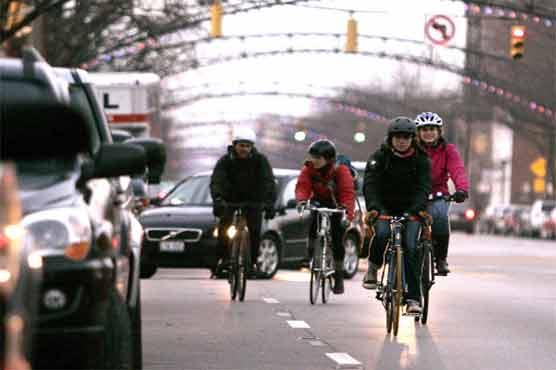
For the laymen, cycling, and track cycling in particular, can be a little baffling.Why in Victoria Pendletons second race with Anna Meares did the competitors start off so slowly? Why did they almost stop at the top of the velodrome track?Why does the person behind in a sprint so often win? Why does the lead cyclist in a team event drop off and rejoin at the back?The answers provide fans with a practical lesson in physics.Drafting or the importance of slipstreamsThe science of the slipstream explains some of the cycling tactics that seem oddest to the layman.The biggest enemy for the cyclist is wind resistance, says Chris Sidwells, author of the Official Tour de France Records book. One way to get round this is to use another riders slipstream, known as drafting. This is created by a cyclists drag.Anybody who has ever been inside a house knows that solid objects like brick walls offer shelter from the wind, says Dutch novelist and cycling fan Tim Krabbe, author of The Rider. The same principle applies to persons on bikes - people riding behind are sheltered, although not as much as by brick walls.The rider at the front uses about a third more energy than those behind, says Chris Sidwells, author of the Official Tour de France Records.You have to be tucked in closely to the rider in front to gain this protection - the closer the better.Youre talking about an inch or two in the Tour, says physicist Dr Lisa Jardine-Wright of Cavendish Laboratory, Cambridge University. Thats why there are so many pile-ups.More than the length of a bicycle and the benefit of slipstream disappears in road racing.Chris Boardman, head of research and development at Team GB, says that on the track, you can get even closer because there are no cross-winds. Theyll often touch in the team pursuit, thats how close they are. If youre millimetres behind - what we practise for in Team GB - then its like sheltering behind a wall.Without knowing a riders body position and speed, its hard to give an exact figure on what slipstream theyll create, says Prof Michael Leschziner, professor of computational aerodynamics at Imperial College London. Its such a complex area of physics that it requires each athlete to be tested in a wind tunnel before one can precisely quantify the slipstream.If you think about the slipstream as a pocket of air, there is a rough formula for the size created by a moving disc, Leschziner says. It is about three times the diameter of the disc. So if a disc is one metre wide, the air pocket behind would be three metres long.However, cyclists are not disc-shaped. The riding position, clothing and bike are all designed to create the minimum of wind resistance. The main drag is created by the cyclists body.It means the air pocket behind will be considerably shorter than three times the width of the cyclists body. This explains why the cyclists need to get so close.