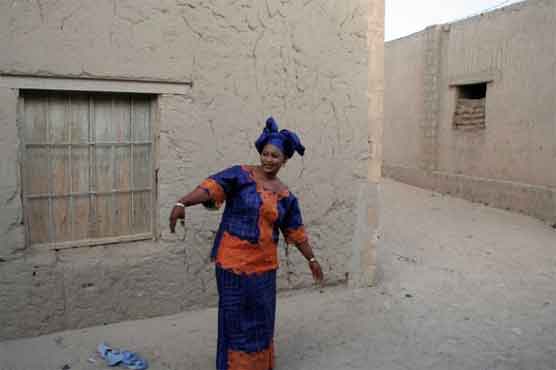
Summary She wasn't sure if the veil had fallen off with flogging, she could feel blood seeping through.
TIMBUKTU: The love story in this fabled desert outpost began over the phone, when he dialed the wrong number. It nearly ended with the couple s death at the hands of Islamic extremists who considered their romance forbidden.
Al-Qaida-linked militants terrorized the population, whipping women and girls in northern Mali almost every day for not adhering to their interpretation of the strict moral code.
Salaka Djicke helped her mother bake bread in a mud oven, selling each puffy piece for 50 francs (10 cents). In the afternoon, she grilled meat on an open fire and sold brochettes on the side of the road. She saved the money she earned to buy herself makeup and get her hair styled.
Like her sisters and friends, she spoke openly with men including the stranger who called her by mistake more than a year ago.
The man thought he was calling his cousin. When he heard Salaka s voice, he apologized. His voice was polite but firm, with the authoritative cadence of a man in his prime. Hers was flirtatious, and her laugh betrayed her youth. They started talking.
A few days later, he called her again. For two weeks, they spoke nearly every day, until he asked for directions to her house.
She explained how to find the mud house on Rue 141, past the water tower also made of mud, in a neighborhood less than a mile from where he sold gasoline from jerrycans by the roadside. She had time to put on a yellow dress. He arrived on his motorcycle.
He was older - she does not know how old -- and already married, a status that bears no taboo in a predominantly Muslim region where men can take up to four wives. She found him handsome.
From that day on, he ended phone conversations with the phrase, Ye bani, or "I love you" in the Sonrai language. Instead of Salaka, he called her "cherie" sweetheart in French, still spoken in this former French colony.
By the time the first group of rebel fighters carrying the flag of the National Movement for the Liberation of the Azawad drove past her house on April 1, the two had been seeing each other for several months. He called to see if she was OK.
As their love affair grew more intense, so did the crackdown by the Islamists in northern Mali, an area equal in size to Afghanistan.
Three months after they arrived, they arrested an illiterate man and woman, both dirt-poor herders living together for years with their animals outside the town of Aguelhok. The man had left his wife to reunite with his teenage love, and they had two children out of wedlock, the youngest just six months old.
The fear was now palpable on the streets of Timbuktu. Salaka and her boyfriend stopped seeing each other in public. When he came, they sat in the enclosed courtyard of her parents home, behind the veil of its chrome-red dirt walls.
Even in relatively modern Timbuktu, it was not considered appropriate to leave the couple alone in a room.
So he arranged for a friend to loan him the keys to his empty house in a neighborhood less than a mile away.
They began meeting once a week. She insisted on staying no longer than 40 minutes. He brought her on his motorcycle, stopping close to the house and pushing the bike through a blanket of sand to avoid attention.
By this time, the Islamists were beating everyone from pregnant mothers and grandmothers to 9-year-olds for not covering themselves fully.
.
At a certain point Salaka knew they were going to get caught. She planned out what they would say.
In one version, she would say he was her uncle. In another she would call him her older brother. In yet another, they would try to pass off as a married couple.
On the night of Dec 31, the two left Salaka s house on a motorcycle, headed west and turned onto Road No 160.
They passed the bread oven belonging to one of her mother s competitors. They skirted an alley crowded with handmade bricks laid out to dry.
They turned left, and then right again, taking a circuitous path to confuse anyone who might be following them.
When they got close, they chose the narrowest alleyways, used only by motorcycles and donkey carts instead of the Toyota pickup trucks of the Islamic police.
They passed the house where they planned to meet and doubled back in an alley. He cut the motorcycle s engine, told her to stay 100 yards behind him and pushed the bike through the sand as usual.
She watched him leave. She was breathing so hard she was afraid the stars could hear her. He passed the first intersection, then the second, and then the third.
The bearded men came on foot via the third intersection. There were four of them. Her lover jumped on his motorcycle and gunned it across the sand. He was the married one and would have paid the higher price.
She knew she couldn t outrun them. So she stood. And in the moments it took for them to descend on her, she realized it would be futile to lie.
They took her to the headquarters of the Islamic police, inside a branch of the local bank. They shoved her into the closet-like space where the ATM machine is located and locked the gate behind her.
When she didn t come home that night, her worried sister called her cell phone. The Islamic police answered and told her where Salaka was.
In the morning, her family came to slip her a piece of bread through the grills of the gate, feeding her like an animal at the zoo. Later that day, the police transferred her to a prison they had set up just for women in a wing of the city s central jail. For the next three nights, she slept alone on a hard floor in a large, cement room.
On Jan. 3 they took her to the Islamic tribunal. Just eight days before French President Francois Hollande unilaterally approved a military intervention in Mali on Jan. 11, Salaka was sentenced to 95 lashes.
They took her to the market at noon on Jan. 4, the same place where she bought the beef for the brochettes she sold and the flour used to make her mother s flatbread. She recognized the meat sellers. One of them used his phone to record what happened next.
The police made her kneel in a traffic circle. They covered her in a gauze-like shroud. They told her to remove her dress, leaving only the thin fabric to protect her skin from the whip. Curious children jostled for a better view.
What they did to her was witnessed by dozens of people in Timbuktu, and can still be heard on the meat seller s cell phone.
A man announced Salaka s crime and her punishment. Then he began flogging her with a switch made from the branch of a tree. Her high-pitched cries are contorted with pain. You can hear the slap of the whip. You can hear her labored breathing.
They hit her so hard and for so long that at one point she wasn t sure if the veil had fallen off. She could feel the blood seeping through.
When it was over, they told her that if they ever saw her with a man again, they would kill her.
Her lover called as soon as she got home. The night she was caught, he ran away to Mali s distant capital, becoming one of an estimated 385,000 people who have fled their homes from the north.
He said over and over: "I m sorry." He promised to marry her. But he has not yet returned. She still will not name him, fearing the Islamist extremists will be back.