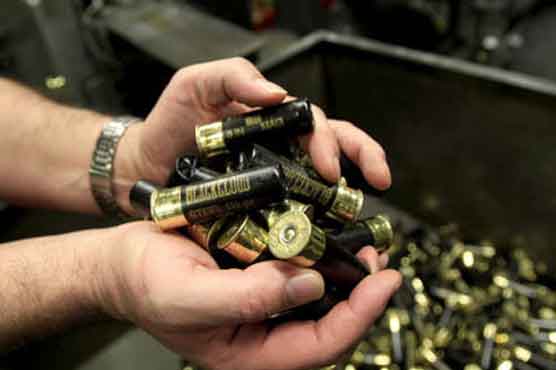
Summary In 2012, Chicago police seized more than 7,400 guns about 3 times more than officers in New York.
CHICAGO: They are counting the dead from gunfire again in Chicago, a city awash in weapons despite having one of the strictest gun-control ordinances in the U.S.
After a year in which Chicago's death toll surpassed 500, the bloodshed has continued in 2013 at a rate of more than one killing a day. It was the city's deadliest January in more than a decade.
Now with this week's death of a 15-year-old drum majorette who had just returned from performing at President Barack Obama's inauguration, the mounting losses have put Obama's hometown at the center of the intensifying national debate over guns.
The slayings are no longer dismissed as an only-in-Chicago story about violent street gangs. They are unfolding in an almost slow motion version of the Connecticut elementary school attack that killed 20 children last month.
An honor student was gunned down at a high school basketball game, two men in their 40s were killed outside a hamburger stand, a woman's bullet-riddled body was found early Friday in a van on the world-famous Lake Shore Drive.
Both gun-rights and gun-control advocates are seizing on the city's woes one side to push for greater access to guns for self-defense, the other to seek greater restrictions on gun sales.
Obama has made a point of mentioning the gun violence in Chicago when he laments the massacre in Connecticut and the Colorado movie theater shooting last year that left 12 people dead.
He offered condolences to the family of Hadiya Pendleton, the promising teen who was shot to death Tuesday as she talked with friends after school in a park near Obama's Chicago home. He stressed later that the threat posed by guns in his hometown is part of a larger story about dangers across the nation.
"I mean what is absolutely true is that, if you are just creating a bunch of pockets of gun laws without having sort of, a unified, integrated system for example, of background checks then ... it's going to be a lot harder for an individual community, a single community, to protect itself from this kind of gun violence," the president said in an interview with Telemundo.
His political opponents are making the most of the body count, too.
Newt Gingrich, a former speaker of the House of Representatives, says he's trying to persuade House Republicans to hold hearings on Chicago's shootings. During an interview on CBS News, Gingrich called the city "the murder capital of the United States," adding, "If gun control works, Chicago ought to be safe."
Critics of gun control say Chicago's spike in homicides offers clear evidence that sharply restricting weapons endangers the public. The city banned handguns until a 2010 Supreme Court ruling threw out the ban. Chicago then adopted a strict gun ordinance that requires gun owners to be fingerprinted, undergo a background check, pass a training class and pay fees that can be higher than the price of the weapons.
"If you restrict firearms, only criminals have firearms," said Richard Pearson, executive director of the Illinois State Rifle Association. "In the city of Chicago, the citizens are simply looked at as easy prey because it is so difficult to have a firearm at home or your business for self-defense."
From the other side comes another familiar argument that Chicago illustrates the need for tougher restrictions because existing laws in the city and beyond its borders in the suburbs or Indiana have made it too easy for criminals to get guns and too difficult to lock them up when they are caught.
Gingrich "has been in Chicago, and he can see we don't have a Berlin-type wall with checkpoints around it," said Rep. Mike Quigley, a Chicago Democrat. "You can go to any gun show in Indiana ... and get a gun without a background check."
Statistics show that more than half of the guns seized by Chicago police in the last 12 years came from other states.
And a University of Chicago study found that more than 1,300 guns confiscated by police since 2008 were purchased at a single store just outside city limits. More than 270 were used in crimes.
Chicago leaders have embraced the city's role in the debate.
Mayor Rahm Emanuel is proposing a law to increase jail time for anyone who fails to report guns that have been lost, stolen or sold. At the U.S. Conference of Mayors, he urged fellow leaders to follow his example and sever financial ties with gun manufacturers that oppose gun-reform legislation.
His police superintendent, Garry McCarthy, has repeatedly compared the laws in Chicago and New York, where he spent the bulk of his career on the city's police force.
"When people get caught with guns in New York, they go to jail," McCarthy said, pointing to the case of Plaxico Burress, the football player who only had to shoot himself accidentally in the leg to land in prison for 20 months.
Although Chicago has many gun laws on the books, the maximum penalties are typically no more than six months in jail, "which is something that a criminal laughs at," McCarthy said.
In 2012, Chicago police seized more than 7,400 guns about three times more than officers in New York. In the first three-plus weeks of this year, police seized 450 guns, compared with 99 in New York. McCarthy says that disparity helps explain why Chicago's homicide rate rose last year while New York's fell to a historic low.
For residents of some troubled neighborhoods, the abundance of weapons helps explain why they hear so many gunshots so often.
"People are afraid to go out, sit on their porches," said Nathaniel Pendleton, the grand uncle of Hadiya Pendleton. "It's horrific. Every family is suffering."
It was Pendleton's death that drew Chicago fully into the debate in a way that last year's 506 gun slayings and the 43 so far this year did not.
The Rev. Michael Pfleger, a Catholic priest and a prominent community activist on the city's South Side, said the slaying of a popular student with dreams of becoming a doctor or lawyer caught the attention of Americans who are not typically touched by inner-city violence. The teen had even made an anti-gang video.
"This was a young girl," he said. "And I talk to people in the suburbs and they're devastated by this."