Summary The programme is designed to fund large-scale technical skills training
(Web Desk) - Pakistan has put in place its first private-capital-funded Skills Impact Bond, backed by Rs1bn guarantee from the Ministry of Finance.
The initiative introduces an outcome-linked financing structure for technical and vocational training that ties public repayments to employment results rather than upfront spending.
The Pakistan Skills Impact Bond (PSIB) is structured as a three-year instrument, with the initial Rs1bn pilot tranche guaranteed by the federal government, according to the press release.
The programme is designed to fund large-scale technical skills training.
Repayments are conditioned on independently verified outcomes, including certification, job placement and a minimum six-month employment retention period for each trainee.
Unlike traditional public sector training programmes that disburse funds based on inputs such as enrolment or infrastructure, the PSIB shifts financial risk to private investors, who provide upfront capital.
Government-backed payments are triggered only if agreed outcomes are achieved.
Those involved in the programme said subsequent tranches are expected to progressively reduce reliance on sovereign guarantees.
They are also expected to introduce partial repayment mechanisms linked to a nominal share of trainee salaries, creating a more sustainable, market-linked model.
The initiative is anchored within Pakistan’s newly developed Social Impact Financing Framework.
The framework identifies education and human capital as the top national priority, followed by gender equality, health and well-being, population stabilisation, climate resilience, and poverty and migration.
The framework was developed through a multi-stakeholder process involving policymakers, development partners, financial institutions, technology providers and international organisations.
The skills bond is being implemented through the National Vocational and Technical Training Commission (NAVTTC), which will oversee programme execution, training standards and outcome verification.
The Bank of Punjab is participating as a key financial partner, while the British Asian Trust is acting as programme manager.
The UK’s Foreign, Commonwealth & Development Office (FCDO) is also supporting the initiative.
According to programme details, at least 40% of trainees under the PSIB will be women, reflecting efforts to address gender gaps in workforce participation and income generation.
The training focus includes technical and high-value digital skills aligned with domestic industry demand and overseas employment markets, as well as Pakistan’s growing freelance economy.
Finance Minister Senator Muhammad Aurangzeb said the government’s role in providing the Rs1bn guarantee is intended to be catalytic rather than permanent.
The measure is aimed at attracting private capital and establishing credibility for outcome-based social financing in Pakistan.
He noted that the longer-term objective is to transition toward a model that operates without government balance-sheet exposure and draws participation from institutional and capital market investors.
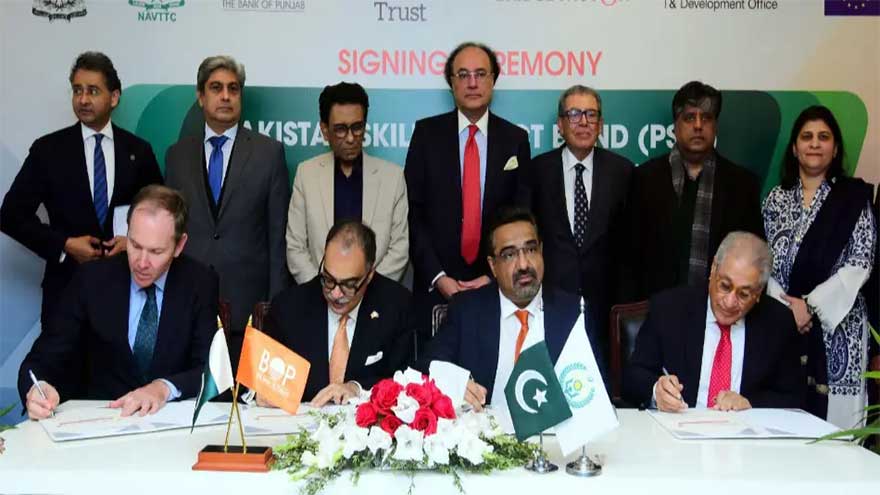
The launch event also included the signing of financing documents, including investor and issuer agreements, formalising the structure of the bond and the roles of participating stakeholders.
The model comes at a time when policymakers are seeking to improve training effectiveness, employment outcomes and fiscal efficiency while leveraging private capital for public policy goals.