
Updated on
Summary Thousands of Greek protestors poured into the streets hours before a key austerity vote.
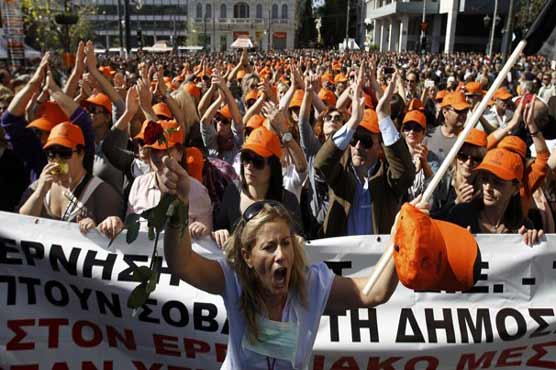
On Thursday more grim news battered the eurozone just days ahead of a crunch summit on Europes debt crisis.Police fired tear gas as clashes broke out with hooded protesters on the sidelines of a rally in central Syntagma Square, where 35,000 people gathered on the second day of a general strike that has crippled the public sector and much of the country. Demonstrators were planning to encircle parliament where lawmakers were to hold the final vote on the bill that introduces collective wage amendments, major tax break cuts, a new civil service salary system and temporary layoffs for thousands of public sector staff.The government has repeatedly warned that the bill is needed to avert a public debt default, but to people in the streets the measures mean a further belt-tightening in a country that has been mired in recession for months. I am a pensioner and they are reducing the already reduced pensions, Georgia Tardeli told AFP. The worst is the prospects this country has with the youth. The unemployment, the lack of goals. The lack of prospects and hope.”Although Greeces austerity bill passed a first, largely procedural reading late on Wednesday, a number of government deputies have threatened to reject an article on wage amendments in Thursdays follow-up vote. Finance Minister Evangelos Venizelos told parliament on Wednesday that Greece faced a battle of all battles in Brussels, where EU ministers were to meet from Friday, and would be unable to finalise its budget without the bill.A Greek newspaper reported on Thursday that a disagreement between the EU and the IMF could actually delay the auditors report needed to release the critical funds. A leading government official on Thursday warned EU policymakers that the violence that marred the Greek protests on Wednesday -- at least 45 people were injured and scores of stores, banks and hotels vandalised -- would spread to other countries unless a conclusive solution to the debt crisis was reached.I call on the Europeans to see what happened yesterday because this cannot go on. Public anger will expand everywhere. They must stop fooling around conclusive solutions are needed, the ruling partys chief whip Christos Protopappas told Flash Radio.European Commission President Jose Manuel Barroso urged Europes leaders to show compromise ahead of the summit and said it was vital to agree to strengthen the European Financial Stability Facility (EFSF), the blocs primary weapon to stem the crisis.Germanys finance minister Wolfgang Schaeuble said on Thursday that Paris and Berlin were in complete agreement on the EUs bailout fund, but no accord had yet been clinched at a European level. According to one diplomat, EU leaders will discuss boosting the funds capacity to between one and two trillion euros from the current 440 billion euros, an insufficient sum should other struggles like Italy or Spain need a lifeline.Economic outlook prior to the summit remained grim, with Germany, eurozones largest economy, expected to halve its growth forecast for next year when it releases updated economic indicators. Having up to now weathered the economic storm better than its eurozone peers, Germany is expected to slash its growth forecast to 1.0 percent for 2012, from the 1.8 percent it had projected in April, according to government sources.And ratings agencies kept up their bad-news torrent, with Moodys cutting its debt ratings of five Spanish banks and most of the countrys regions, and Standard and Poors downgrading the sovereign credit rating of Slovenia. Amid the steady flow of downgrades, the European Commission is reportedly considering banning the ratings agencies from publishing assessments of EU countries in difficulties, the Financial Time Deutschland reported on Thursday.France also received worrying news when the Zurich-based Bank of International Settlements said that French banks were the biggest lenders to Greece and Italy, with about half of Italian foreign debt -- $416.37 billion -- owed to French lenders.The data comes just days after France was warned by Moodys that it could lose its prized triple-A rating because the current economic crisis has significantly affected its fiscal health.Underlining the urgency of the eurozone crisis, French President Nicolas Sarkozy left his wife in labour at a Paris clinic late Wednesday to rush to Frankfurt for talks with German Chancellor Angela Merkel, missing the birth of the couples first child and his first daughter after three sons. The leaders of eurozones top two economies have both vowed to save the euro, warning that its failure could destroy Europe.