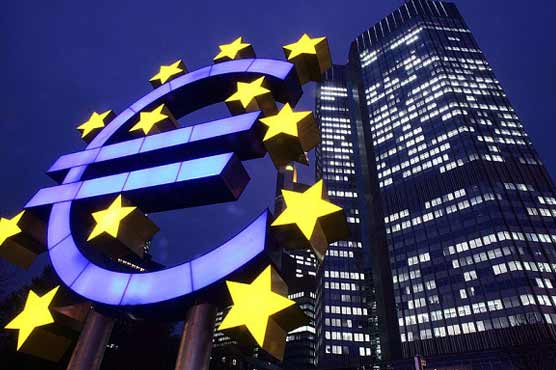
Summary The European Central Bank (ECB) took financial markets by surprise last month.
FRANKFURT (AFP) - The European Central Bank, which recently cut its interest rates to all-time lows, finds itself in the spotlight at its final meeting of the year Thursday to disperse the spectre of deflation.
The ECB took financial markets by surprise last month and pared back its central "refi" refinancing rate by a quarter of a percentage point to a record low of 0.25 percent.
The trigger for the move was an unexpectedly sharp slowdown in area-wide inflation to just 0.7 percent in October.
In November, the inflation rate increased fractionally to 0.9 percent.
But analysts believe that that does not sound the all-clear and the ECB cannot simply sit back and do nothing.
"The cut in rates has not markedly relieved the pressure on the central bank to take additional action to support what remains a very fragile economic recovery and head off deflation," said Capital Economics economist Jonathan Loynes.
Marie Diron at EY Eurozone Forecast agreed.
"We think that the ECB needs to recognise the risk of deflation more clearly and act pre-emptively," she said.
ECB officials have been keen to stress that they believe what the eurozone is currently experiencing is "disinflation" not "deflation".
Disinflation describes slowing price rises which remain in positive territory but reflect a stagnating economy in which growth and jobs are elusive.
By comparison, deflation is where prices fall in real terms, which encourages consumers to put off buying goods in the expectation that if they wait, they will get them cheaper.
That dampens demand, adding to the downward pressure in the economy as companies hold back investment, in turn impacting jobs and demand in a vicious circle seen at its worst in the 1930's Great Depression.
ECB staff forecasts may give clue to further action
===================================================
Key to any possible new action by the ECB will be the central bank's own staff projections for growth and inflation in the 17 countries that share the euro, which it is scheduled to publish after Thursday's meeting.
"These will be the focus" of ECB chief Mario Draghi's regular post-meeting press conference, said Deka Bank economist Ulrich Kater.
"At the last meeting, Draghi described the deflationary dangers as very low. The data published since then support this assessment. As a result, no new measures are expected at this week's policy meeting," Kater said.
Berenberg Bank economist Christian Schulz said the latest inflation data reduce "any pressure for more monetary policy action, which could spark vocal opposition from the hawks on the (governing) council."
The inflation numbers, combined with a drop in euro-area unemployment, "provide welcome news (for the ECB) as they prepare" for the last policy meeting of the year, Schulz said.
The data could even "strengthen the hawks' arguments that the November rate cut may have come too early," the expert said.
Certainly, in Germany, where economic slack is far less, inflation could be heading towards the 2.0-percent target a bit sooner and that "should strengthen Bundesbank President Jens Weidmann's resistance to further policy action," Schulz said.
"But for now, appetite for such action might be limited in the ECB as a whole."
Diron at EY Eurozone Forecast said further action from the ECB could take the form of providing clearer forward guidance as to when the next rate cut might come.
The central bank could also roll out new liquidity measures, such as the long-term refinancing operations, or LTROs, which it used at the end of 2011 and early 2012 to avert a looming credit crunch.
Commerzbank economist Michael Schubert also felt that "comments from ECB council members in recent weeks tend to suggest that after the rate cut at its last meeting the council will decide no further measures on Thursday."
However, he said that the ECB had demonstrated that it reacts quickly even when only little new information calls its assessment into question.
"Should the ECB projections for 2015, for example, fall noticeably short of the figures the council previously assumed, the ECB might respond," Schubert said.