Summary Italy held its final day of campaigning on Friday ahead of crucial elections.
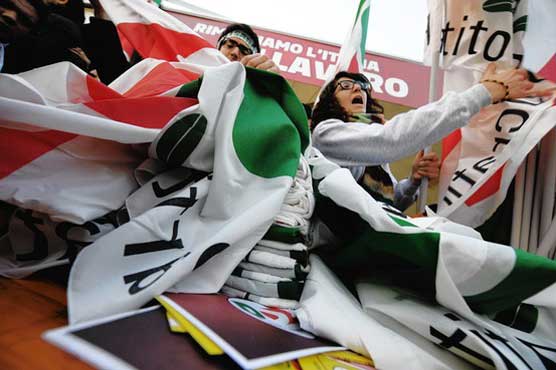
ROME, Feb 22, 2013 (AFP) - Italy held its final day of campaigning on Friday ahead of crucial elections, as international investors warned an unclear outcome could shake the economy and set off shockwaves through the eurozone.
Italians will cast their ballots on Sunday and Monday as they grapple with the longest recession in two decades and austerity cuts that have caused deep resentment in the euro area s third economy.
The most likely outcome is a centre-left government led by Democratic Party leader Pier Luigi Bersani, a former communist with a down-to-earth manner who now espouses broadly pro-market economic views.
"I am very, very confident of victory although we should not underestimate the right," Bersani said in one of his last television interviews ahead of Saturday, when no campaigning is allowed.
But the result is by no means certain and whether Bersani can form a stable coalition with a majority in both houses of parliament is in serious doubt, putting the financial markets on edge.
The European Commission added further pressure on Friday, downgrading its forecast for the Italian economy to a 1.0-percent contraction this year from its previous forecast of a 0.5-percent shrinkage.
Bersani is due to address his last electoral meeting in Rome later on Friday, while his rival Silvio Berlusconi will address a rally in Naples.
With everything at stake, the campaign has been remarkably underwhelming, with few rallies and a lot of back-and-forth in television interviews with little or no hard detail on electoral promises.
A case in point was Silvio Berlusconi s vow to refund Italians an unpopular property tax levied by Prime Minister Mario Monti in an official-looking letter that prompted some people to queue up at post offices to claim their money straight away.
European capitals and foreign investors will be watching closely as a return to Italy s free-wheeling public finances could spell disaster for the eurozone.
"We believe that a risk exists that after the February 24-25 elections there may be a loss of momentum on important reforms to improve Italian growth prospects," Standard & Poor s ratings agency said in a report this week.
London-based Capital Economics warned that even with a stable governing majority "huge underlying economic problems suggest that it may only be a matter of time before concerns about the public finances begin to build again."
"And a hung parliament might plunge Italy and the eurozone back into crisis rather sooner," the economic research company said this week.
Polls open at 0700 GMT on Sunday and close at 1900 GMT. A second day of voting on Monday begins at 0600 GMT and ends at 1400 GMT, after which preliminary results will begin to trickle through late Monday and into Tuesday.