Summary The vote marked another step in the government coalition's efforts to meet demands of its creditors.
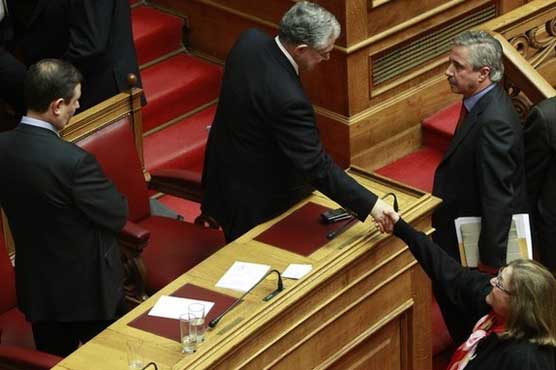
The Greek parliament on Sunday approved a slashed 2013 budget which the government has vowed will secure the release of foreign aid vital to save the debt-ridden country from insolvency.
The vote marked another step in the government coalition s efforts to meet the demands of its creditors after a separate package was approved on Wednesday.
The austerity measures, which will result in salary and pension cuts across the board, are deeply unpopular and have fueled sometimes violent protests in the capital Athens.
The vote passed with a comfortable majority of 167 deputies in favour from the 300-seat chamber, though only after an impassioned debate.
The vote paves the way for the European Union, International Monetary Fund and the European Central Bank to unlock a 31.5 billion euro ($40 billion) tranche of bailout funds.
Greece s unrelenting debt problems will top the agenda Monday when Eurozone finance ministers discuss whether Athens has met all the conditions set by its international creditors to provide funds so it can stay afloat.
Prime Minister Antonis Samaras, was relieved to see his coalition government hold together, just four days after a vote on another round of austerity cuts was passed with a parliamentary majority of just three.
"The second decisive step has been taken, now it s time for growth and recovery," he said after the vote.
During the debate preceding Sunday s vote, Finance Minister Yannis Stournaras said the budget, which includes 9.4 billion euros ($12 billion) in cuts, would guarantee the funds.
"I assure you in the most categoric manner that the tranche (of aid funds) will be released in an imminent fashion," he said.
Europe s paymaster Germany was less categorical earlier this week and said the ball was in the Greek camp.
Police estimated that around 15,000 protestors had massed outside parliament before the vote.
"The measures will pass but we are here to prove that we are not resigned to it," Olga P., 35, an English teacher in a public school, said before the vote.
Sunday s protest was called by both the public-sector Adedy union and the private-sector GSEE union. A GSEE statement called urged to reject the austerity policies.
A banner from the opposition radical left-wing Syriza party called for the government s downfall. The country is currently surviving on two massive bailouts from its international creditors. The vote came on the eve of a eurozone finance ministers meeting, during which Athens progress on carrying out required reforms and cuts will be scrutinised.
Without the fresh funds, Greece risks default on November 16, when the government -- in the midst of its biggest crisis since taking office in June -- must repay a three-month treasury bill worth five billion euros.
German Finance Minister Wolfgang Schaeuble said in an interview with Sunday s Die Welt newspaper that the ball was in Greece s court even after lawmakers approved the latest 18.5 billion euro austerity package demanded by creditors.
"Nobody in the eurozone opposes the idea of accepting the payment of the next tranche of aid," he added. "But only when the conditions have been met. And that, that is for the government in Athens to take care of."
The 2013 budget predicts the economy will shrink by a worse-than-expected 4.5 percent next year, the sixth year of recession, while the public deficit -- the shortfall between government revenue and spending -- is forecast to rise to 5.2 percent of gross domestic product.